Which One Is Better SQL or MongoDB in 2026?
Home / Blog
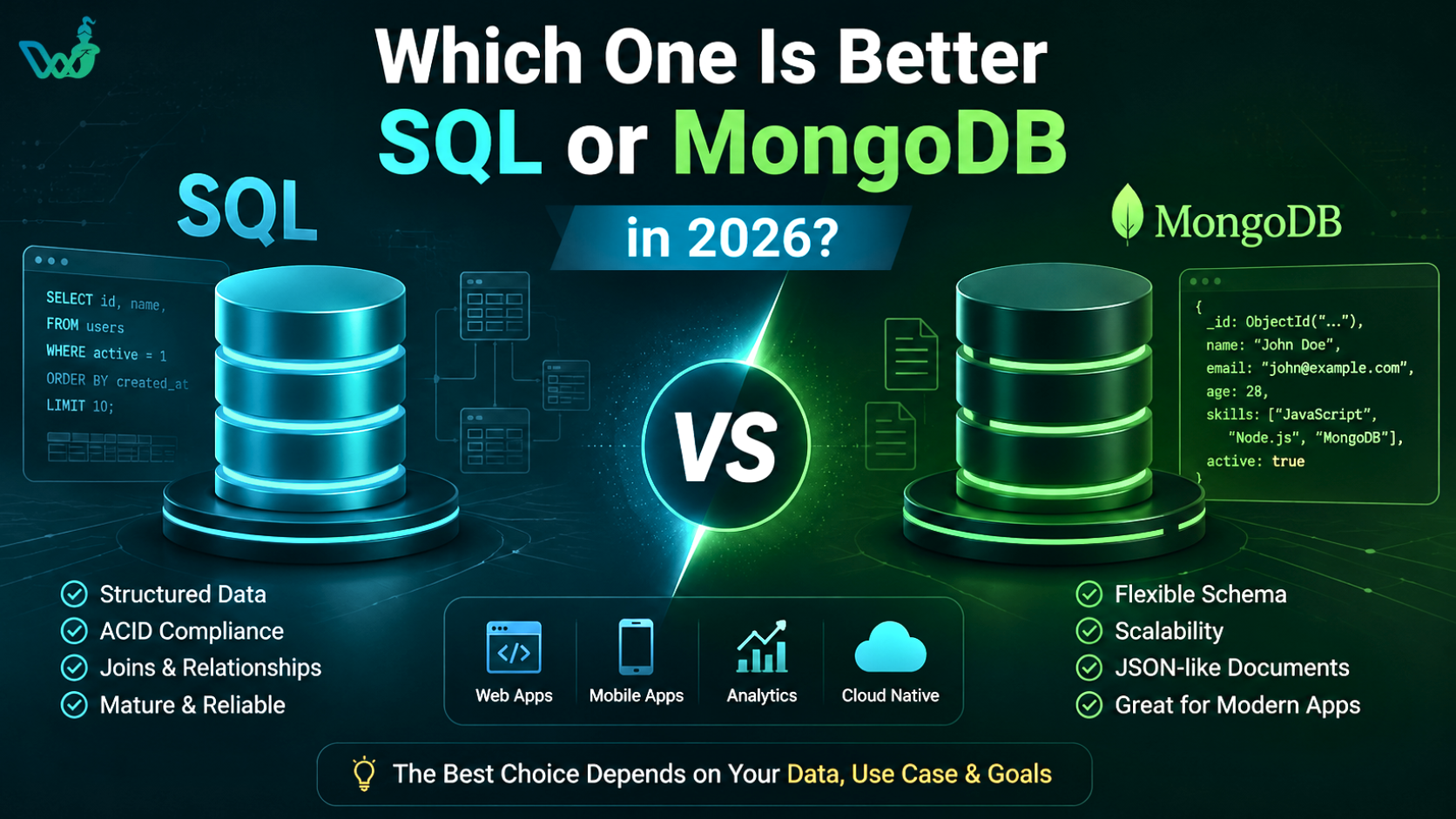
Choosing between SQL and MongoDB can affect how well your application performs. Many developers struggle to select the right database for their projects. The wrong choice can lead to performance issues, scaling challenges, and complex data management.
SQL and MongoDB solve different database needs. SQL uses structured tables and relationships, while MongoDB uses flexible documents. Understanding these differences helps developers, startups, and businesses choose a database that matches their goals.
This article explains which one is better SQL or MongoDB in 2026. You will learn their differences, performance, scalability, advantages, limitations, and ideal use cases. It will help you make the right database decision.
SQL vs MongoDB — Which Database Is Better in 2026?
SQL is better for structured applications with complex relationships and strict transactions. MongoDB is better for flexible applications with changing data requirements. The right choice depends on data structure, scalability needs, and application goals.
Why Choosing the Right Database Matters
The selected database directly impacts application performance, scalability, and data management efficiency. Banking platforms, healthcare systems, and financial software require accurate transactions and consistent records.
Applications managing millions of records, such as e-commerce stores and enterprise platforms, need reliable storage and fast query performance. The database should align with specific project requirements.
SQL databases handle fixed data structures and complex relationships. They organize information using tables, rows, columns, and foreign keys.
MongoDB handles flexible data structures through document-based storage. Developers can modify schemas faster when application requirements change.
Quick Comparison Between SQL and MongoDB
| Feature | SQL Database | MongoDB |
| Database Type | Relational Database | NoSQL Document Database |
| Data Structure | Tables, Rows, Columns | Documents and Collections |
| Schema | Fixed Schema | Flexible Schema |
| Query Language | SQL Commands | MongoDB Query Language (MQL) |
| Relationships | Primary Keys, Foreign Keys, JOINs | Embedded Documents and References |
| Transactions | Strong ACID Transactions | Supports Multi-Document Transactions |
| Scaling Method | Vertical Scaling + Replication | Horizontal Scaling through Sharding |
| Best For | Banking, ERP, Financial Systems | Content Apps, IoT, Real-Time Apps |
| Data Format | Structured Data | Semi-Structured Data |
| Popular Examples | MySQL, PostgreSQL, SQL Server | MongoDB Atlas, MongoDB Community Edition |
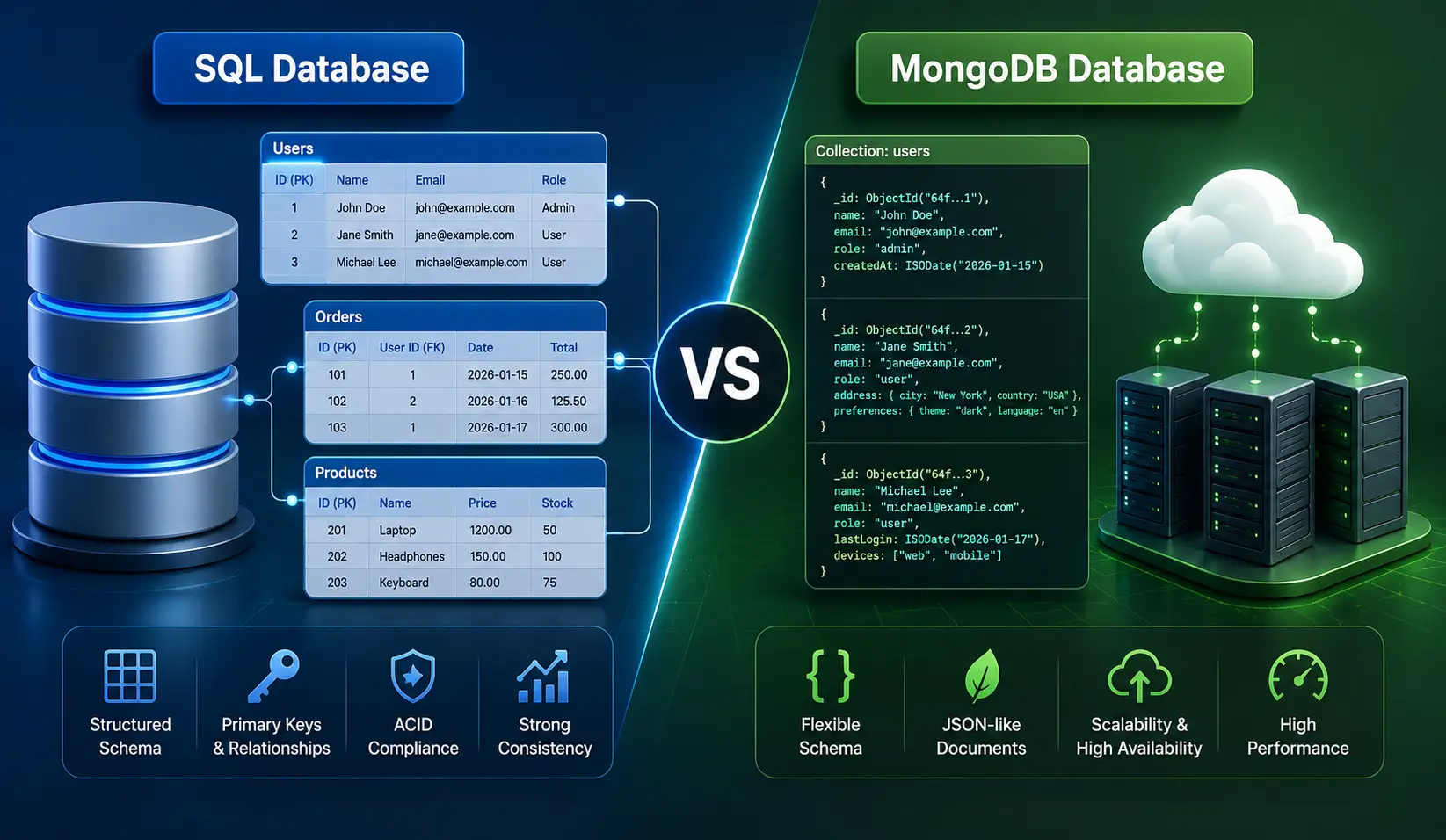
SQL uses a relational database model with structured tables and predefined schemas. Databases like MySQL, PostgreSQL, and SQL Server support complex queries, JOIN operations, and ACID transactions.
MongoDB uses a document database model with collections and JSON-like documents. It supports flexible schemas for applications like content platforms, mobile apps, and IoT systems.
Data relationships work differently in both databases. SQL connects information using tables and foreign keys. MongoDB stores related information inside documents or document references.
Traditional SQL scaling relies on increasing server resources. Modern SQL systems also support replication and distributed architectures.
MongoDB supports horizontal scaling through sharding across multiple servers. This method helps manage large datasets and high-traffic applications.
Both databases can support modern applications. The suitable option depends on data structure, transaction requirements, query complexity, and future growth plans.
What Is SQL Database and How Does It Work?
An SQL database is a relational database system that stores structured data using tables, rows, columns, and relationships. It uses SQL commands to create, retrieve, update, and manage records.
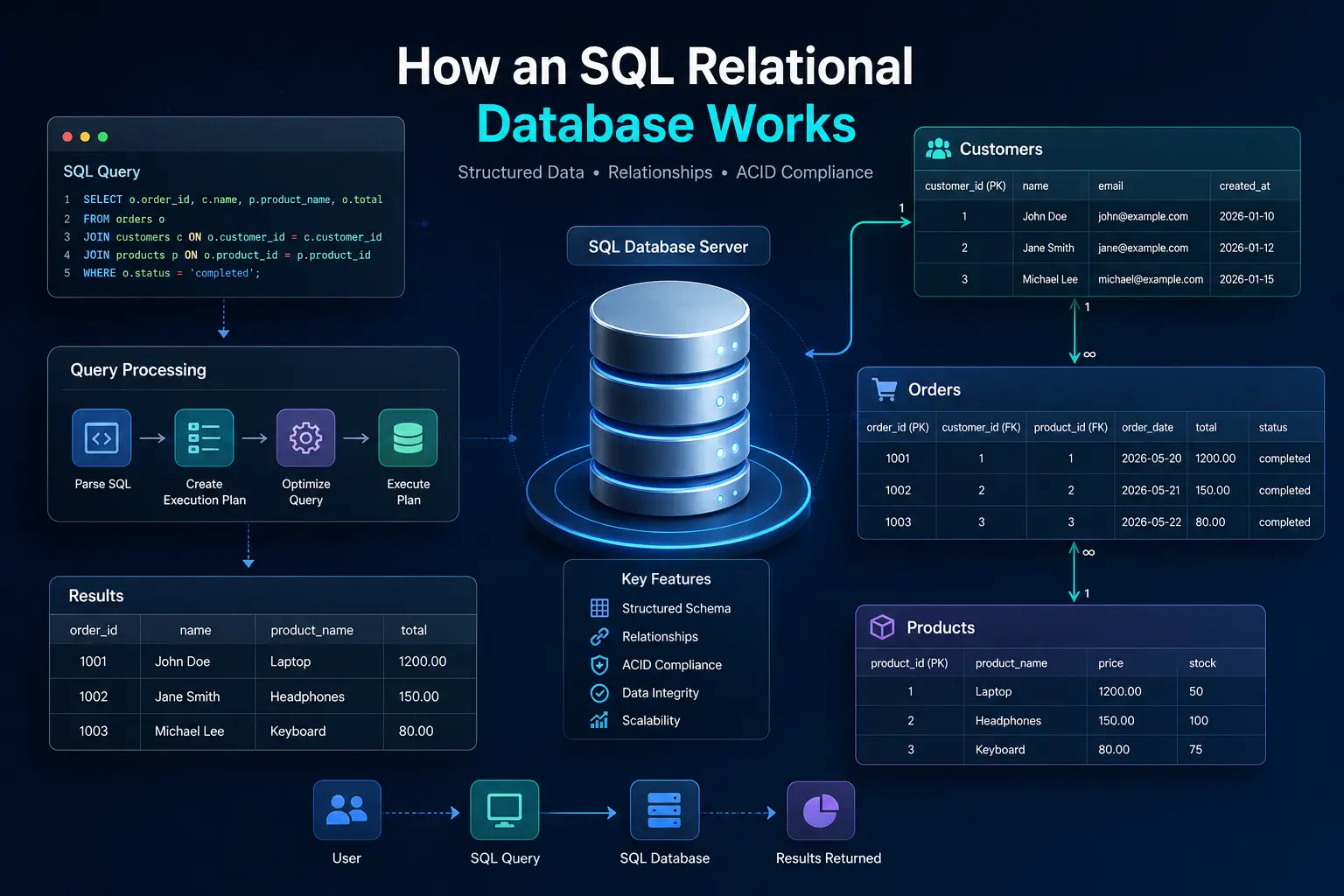
Understanding SQL Relational Database Structure
SQL databases organize data into tables containing rows and columns. Each row represents one record. Each column stores one specific attribute.
A customer table may include columns like customer ID, name, email, and purchase date. Each entry represents one customer record.
Through primary keys and foreign keys, SQL databases connect 2 or more tables through relationships. These connections keep related data accurate.
A sales database can contain tables for customers, orders, and products. These tables connect purchase details with customer information.
SQL follows a fixed schema approach where developers define structures before storing data. The schema controls fields, data types, and table relationships.
This structure works well for applications requiring consistent records. Examples include banking systems, CRM platforms, and inventory management software.
How SQL Handles Data Operations
SQL manages databases through commands like SELECT, INSERT, UPDATE, DELETE, CREATE, and ALTER. These commands retrieve, modify, and organize data.
SQL databases support transactions that combine multiple operations into one process. A bank transfer updates 2 account records within a single transaction.
Each transaction follows ACID properties: Atomicity, Consistency, Isolation, and Durability. These properties maintain accurate and reliable data processing.
Indexes improve SQL query performance by helping databases find records faster. A customer ID index speeds up searches for specific customer data.
Popular SQL Databases
MySQL, PostgreSQL, Microsoft SQL Server, and Oracle Database are popular relational database management systems.
MySQL is widely used for websites, web applications, and content platforms. Businesses often choose professional web development services to build scalable applications powered by databases like MySQL and PostgreSQL.
Microsoft SQL Server is commonly used in enterprise environments. Oracle Database supports business applications that manage millions of records.
SQL databases provide structured storage, reliable transactions, and efficient queries. They support applications that require consistent and organized data management.
What Is MongoDB and How Does It Work?
MongoDB is a NoSQL database that stores data as flexible documents inside collections. It uses document-based queries and distributed architecture to support scalable applications.
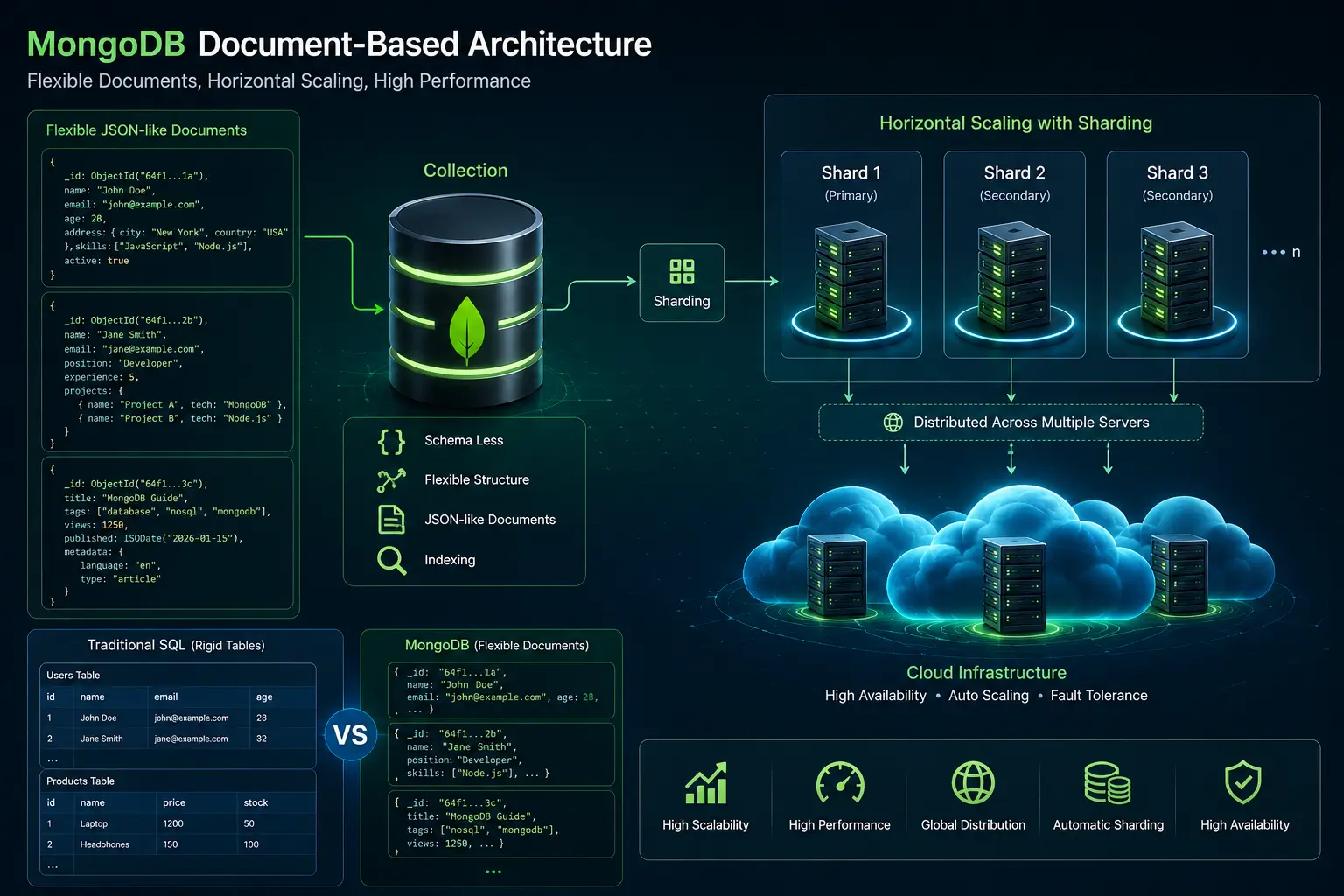
Understanding MongoDB Document-Based Architecture
MongoDB uses a NoSQL database model that stores information without traditional relational tables. Data is organized as documents instead of rows and columns.
The database stores information in documents and collections. Documents contain individual records. Collections store groups of related documents.
A user document can include fields like name, email, address, and order history. A product collection can contain details like price, category, and inventory.
MongoDB stores documents using BSON (Binary JSON). This format extends JSON with data types like dates, integers, and binary values.
MongoDB uses a flexible schema design that allows documents in the same collection to have different fields. Developers can update structures without redesigning database tables.
How MongoDB Manages Data
MongoDB manages data through MongoDB Query Language (MQL). It allows applications to retrieve, update, and filter documents.
For scalability, MongoDB uses horizontal scaling through sharding. Sharding distributes data across 2 or more servers.
This method supports applications managing millions of documents. Examples include social networks, online marketplaces, and streaming platforms.
MongoDB handles semi-structured data like user profiles, product catalogs, and sensor records. The flexible model supports changing data formats.
Indexes improve MongoDB query performance by helping locate records faster. Replica sets provide data redundancy and improve availability.
Popular MongoDB Use Cases
MongoDB supports modern web applications like social platforms, mobile apps, and online stores. Its document model allows frequent feature updates.
Content platforms such as blogs, media websites, and publishing systems use MongoDB for dynamic content storage.
Real-time applications like chat systems, gaming platforms, and analytics dashboards use MongoDB for fast data access.
MongoDB provides document storage, flexible schemas, and scalable operations for applications with changing data requirements.
SQL vs MongoDB: Key Differences in 2026
SQL uses relational tables, while MongoDB uses flexible documents. Their main differences involve schema design, queries, scalability, and transaction handling.
Data Structure and Schema Flexibility
SQL uses a fixed schema model with predefined tables, columns, and data types. Developers define the structure before storing records.
This approach supports structured applications. Examples include banking systems, accounting software, and ERP platforms.
SQL databases connect tables through primary keys and foreign keys. A customer table can link with orders and payment tables.
MongoDB uses a flexible document structure with collections and BSON documents. Documents can contain different fields within the same collection.
This approach supports changing data requirements. Examples include content platforms, mobile applications, and product catalogs.
SQL works well with predictable data structures. MongoDB supports applications where data models change frequently.
Querying and Data Relationships
SQL uses relational queries and JOIN operations to combine information from connected tables. These operations support complex relationships.
An e-commerce database can connect customers, orders, and products through relational queries.
MongoDB uses embedded documents to store related information together. A customer document can include address details and order history.
This structure reduces the need for JOIN operations in many applications. Complex relationships can use references or additional queries.
Performance and Speed Comparison
Database performance depends on query patterns, indexing, and design choices. Both databases improve speed through proper optimization.
SQL performs efficiently with structured queries and indexed relational data. Examples include financial reports, inventory searches, and customer records.
MongoDB performs efficiently with document-based queries. Examples include user profiles, content feeds, and real-time application data.
Indexes improve query performance in both databases. They help locate records without scanning complete datasets.
The Stack Overflow Developer Survey 2025 reported PostgreSQL as one of the leading database technologies among developers.
Scalability Differences
SQL traditionally relies on vertical scaling by increasing CPU, memory, or storage resources. Modern SQL systems also support replication.
MongoDB supports horizontal scaling through sharding across 2 or more servers. Sharding distributes data across servers for larger datasets.
Cloud applications like SaaS platforms, gaming services, and streaming systems require scalable database architectures.
Transaction and Data Consistency
SQL provides ACID transactions with Atomicity, Consistency, Isolation, and Durability. These properties protect critical operations.
Examples include banking transfers, payment processing, and inventory updates.
MongoDB supports multi-document transactions while keeping its flexible document model. This supports applications requiring reliable data updates.
Critical systems require database choices based on consistency needs, query complexity, and application architecture.
SQL Advantages and Disadvantages
SQL databases provide strong consistency, complex relationships, and advanced reporting features. They also require structured design and careful scaling strategies. The benefits and limitations depend on application requirements.
Advantages of SQL Databases
SQL database systems provide strong data consistency through ACID transactions. These properties keep records accurate during critical operations.
Banking systems, payment platforms, and inventory solutions rely on reliable transaction processing.
SQL supports complex relationships using tables, primary keys, foreign keys, and JOIN operations. These features connect 2 or more related tables.
CRM systems, ERP platforms, and reservation systems use these connected data structures.
SQL provides powerful reporting and analytics capabilities through queries, aggregation functions, and structured data analysis.
Businesses use these features for sales reports, financial analysis, and performance dashboards.
SQL database systems include mature security features like authentication, permissions, encryption, and access controls.
Healthcare systems and financial platforms use these features to protect sensitive information.
According to the Stack Overflow Developer Survey 2025, PostgreSQL remained among the most preferred database technologies by developers.
Limitations of SQL Databases
SQL databases have less flexibility for schema changes because tables and columns require predefined structures.
Applications with changing data models may require migrations and additional development work.
Scaling distributed SQL systems can require complex architecture planning. Modern solutions use replication, partitioning, and distributed designs.
Applications managing 10 million or more records may need advanced scaling strategies.
SQL requires careful database design because relationships, indexes, and queries influence performance.
Poor indexing or table design can slow queries and increase maintenance effort.
SQL works well for applications requiring structured data, reliable transactions, and complex relationships.
MongoDB Advantages and Disadvantages
MongoDB provides flexible document storage, schema flexibility, and horizontal scaling. It also requires careful planning for relationships and transactions. The right use case depends on application requirements.
Advantages of MongoDB
MongoDB offers a flexible schema structure through document-based storage. Developers can add or update fields without redesigning database tables.
This structure supports changing data requirements. Examples include content platforms, mobile applications, and product catalogs.
MongoDB can improve development speed because related information can be stored within the same document. Developers can update features without frequent schema migrations.
Startups, web applications, and real-time platforms with changing features can benefit from this approach.
MongoDB supports horizontal scaling through sharding. Data can be distributed across 2 or more servers.
Applications with datasets containing millions of documents can use this model. Examples include social networks, streaming services, and online marketplaces.
MongoDB documentation explains that sharding distributes collections across multiple servers. This feature supports large datasets and high-volume applications.
Limitations of MongoDB
MongoDB requires careful planning for complex relationships because it does not use traditional SQL JOIN operations.
Applications with connected data, such as banking systems and ERP platforms, may need document references.
MongoDB can increase data duplication because developers may store repeated information across multiple documents.
This denormalized structure can improve read performance. However, updates require careful management.
MongoDB may require additional design considerations for transaction-heavy systems with complex multi-step operations.
Examples include financial transfers, accounting systems, and payment processing.
MongoDB supports multi-document transactions. Database design remains important for maintaining consistent data.
MongoDB fits applications that need flexible schemas, scalable architecture, and frequently changing data structures.
SQL vs MongoDB Performance Comparison
SQL performs well for relational queries, while MongoDB performs well for document-based workloads. Performance depends on database design, indexing, and application requirements.
Which Database Is Faster?
MongoDB performs well for document-based workloads that need flexible data retrieval. Proper document design and indexing improve query efficiency.
Examples include content platforms, user profiles, and real-time dashboards.
SQL performs well for relational queries that use connected tables and complex operations. JOIN queries combine data from 2 or more related tables.
Examples include financial reports, inventory systems, and enterprise applications.
Database optimization affects performance in both systems. Query design, indexing, and schema structure influence response times.
Indexes help SQL and MongoDB find records faster. Poor indexing can reduce database performance.
According to the Stack Overflow Developer Survey 2025, PostgreSQL remained one of the most popular database technologies among developers.
Performance Based on Application Requirements
Enterprise software like ERP systems, CRM platforms, and accounting applications often uses SQL. These systems require structured data and reliable transactions.
E-commerce websites like online stores, marketplaces, and shopping platforms may use either database. The choice depends on data structure and query patterns.
MongoDB supports flexible product catalogs with different attributes. SQL manages structured orders, payments, and customer records.
Real-time applications like chat platforms, gaming services, and analytics dashboards can benefit from MongoDB’s document model. It supports frequently updated data.
Data-intensive platforms like recommendation engines, IoT systems, and analytics applications need optimized queries and indexing.
Both SQL and MongoDB deliver strong performance when configured correctly. The database should match data structure, query patterns, and scaling requirements.
SQL vs MongoDB: Which Database Is Better for Different Use Cases?
SQL fits structured applications with strict transactions. MongoDB fits flexible applications with changing data models. The choice depends on schema requirements, query patterns, and scaling goals.
Choose SQL For:
SQL is suitable for banking systems that require strong consistency and reliable transactions. Examples include payment processing, account management, and loan systems.
Healthcare applications like patient records, medical billing, and hospital systems often use SQL. These platforms require accurate data relationships.
Financial software like accounting tools, investment platforms, and reporting systems uses SQL transactions. ACID properties help maintain reliable financial records.
ERP and CRM platforms use SQL to manage connected business information. These systems link customers, products, employees, and operations.
Applications with strict transaction requirements often use SQL. Examples include online payments, inventory updates, and order processing systems.
Choose MongoDB For:
MongoDB fits social media applications like community platforms, messaging services, and content-sharing websites. These systems manage frequently changing user data.
Content management systems like blogs, publishing platforms, and media websites use flexible documents. Content fields can change without redesigning database tables.
IoT applications like smart devices, sensors, and connected equipment generate changing data formats. MongoDB stores semi-structured information efficiently.
Real-time analytics platforms like monitoring dashboards, tracking systems, and event-processing tools use MongoDB. It supports flexible data processing.
Projects with changing requirements often use MongoDB. Examples include startups, mobile applications, and experimental software products.
According to the Stack Overflow Developer Survey 2025, PostgreSQL remained one of the most popular database technologies among developers.
When To Use SQL and MongoDB Together
Hybrid database architecture combines SQL and MongoDB when applications need both relational and flexible storage. Each database handles specific data requirements.
Microservices applications like payment services, user profiles, and analytics modules can use separate databases. Each service selects the most suitable storage system.
A single application can combine 2 database systems based on workload needs. SQL manages transactions, while MongoDB stores dynamic documents.
For example, an e-commerce platform can use SQL for orders and payments. MongoDB can store product descriptions, reviews, and recommendations.
The database choice depends on data structure, transaction needs, and scaling goals. SQL and MongoDB solve different storage requirements.
SQL vs MongoDB for Web Development in 2026
SQL fits web applications with structured data and reliable transactions. MongoDB fits applications with flexible data models. The choice depends on data structure, query needs, and scalability goals.
| Feature | SQL Database | MongoDB |
| Database Type | Relational Database | NoSQL Document Database |
| Data Structure | Tables, Rows, Columns | Documents and Collections |
| Schema | Fixed Schema | Flexible Schema |
| Query Language | SQL Commands | MongoDB Query Language (MQL) |
| Relationships | Primary Keys, Foreign Keys, JOINs | Embedded Documents and References |
| Transactions | Strong ACID Transactions | Supports Multi-Document Transactions |
| Scaling Method | Vertical Scaling + Replication | Horizontal Scaling through Sharding |
| Best For | Banking, ERP, Financial Systems | Content Apps, IoT, Real-Time Apps |
| Data Format | Structured Data | Semi-Structured Data |
| Popular Examples | MySQL, PostgreSQL, SQL Server | MongoDB Atlas, MongoDB Community Edition |
Best Database Choice for Developers
SQL remains important in backend development for applications that manage structured information. Examples include banking portals, e-commerce systems, and enterprise dashboards.
It supports relationships, transactions, and complex queries. Developers use SQL with frameworks like Laravel, Django, and Spring Boot.
MongoDB is used in modern development stacks because it supports flexible documents and schema changes. Examples include Node.js applications, mobile backends, and real-time platforms.
The Stack Overflow Developer Survey 2025 reported PostgreSQL as one of the most popular database technologies among developers.
Projects with structured data often use SQL. Applications with changing data models often use MongoDB.
SQL vs MongoDB for Startups
MongoDB can speed up development because developers can update document structures without redesigning database tables.
Startups creating products like social platforms, content applications, and marketplace websites may benefit from flexible schemas.
SQL supports long-term scalability for startups managing structured business data. Examples include financial platforms, customer management systems, and inventory solutions.
Database costs also influence startup decisions. Managed SQL and MongoDB services can reduce maintenance requirements.
Both databases support scalable web applications. The suitable option depends on data relationships, development speed, and growth plans.
Some startups combine both databases when needed. MongoDB can store user-generated content. SQL can manage payments and account records.
Should You Learn SQL or MongoDB in 2026?
Learning SQL builds essential database skills, while MongoDB adds document database experience for modern development. The right choice depends on career goals, projects, and technology requirements.
| Application Type | Better Choice | Reason |
| Banking Systems | SQL | Requires strict transactions and data consistency |
| Healthcare Systems | SQL | Handles structured patient records and relationships |
| Financial Software | SQL | Supports accurate reporting and ACID transactions |
| ERP and CRM Platforms | SQL | Manages complex business relationships |
| Content Management Systems | MongoDB | Offers flexible fields and changing content structures |
| Social Media Platforms | MongoDB | Handles large volumes of changing user data |
| IoT Applications | MongoDB | Stores semi-structured sensor data |
| Real-Time Analytics | MongoDB | Supports flexible and scalable data processing |
| E-commerce Platforms | Both | SQL handles payments and orders, while MongoDB manages catalogs and reviews |
Why Learning SQL Is Still Important
SQL database skills remain important because companies use relational systems for structured data management. Examples include banking platforms, healthcare systems, and enterprise applications.
Developers learn core database concepts through SQL. These concepts include tables, relationships, queries, indexing, and transactions.
Database knowledge supports careers in backend development, analytics, and administration. Examples include backend engineers, data analysts, and database administrators.
The Stack Overflow Developer Survey 2025 reported PostgreSQL as one of the most popular database technologies among developers.
Why MongoDB Skills Are Valuable
MongoDB skills support modern application development through flexible document storage. Examples include mobile apps, content platforms, and real-time applications.
Cloud-based applications often use managed database services for deployment and maintenance. Examples include MongoDB Atlas and distributed application systems.
MongoDB supports full-stack development through the MERN stack. Examples include applications built with MongoDB, Express.js, React, and Node.js.
Using both databases helps developers understand relational and document-based systems. SQL builds strong database foundations. MongoDB supports flexible application designs.
A practical learning path starts with SQL fundamentals. Developers can add MongoDB for projects requiring flexible data models.
FAQs
Which one is better SQL or MongoDB in 2026?
SQL is better for structured applications that require complex relationships and reliable transactions. MongoDB suits applications with flexible data models and changing requirements. PostgreSQL and MySQL remain popular choices for enterprise systems. MongoDB supports modern applications that need scalable document storage and flexible schemas.
Is MongoDB better than SQL databases for modern applications?
MongoDB is better than SQL for applications that need flexible data structures and faster development cycles. It works well for content platforms, real-time systems, and large-scale applications. SQL remains the stronger choice for complex queries, reporting, and systems that require strict data consistency.
When should I use SQL instead of MongoDB?
You should use SQL when your application depends on structured data, relationships, and reliable transactions. Banking systems, inventory platforms, and financial software commonly use SQL databases. SQL helps maintain data accuracy while supporting complex queries across connected records.
When should I use MongoDB instead of SQL?
You should use MongoDB when your application requires flexible schemas and document-based storage. Social platforms, mobile applications, IoT systems, and content platforms often benefit from MongoDB. It allows developers to change data structures without making major database schema updates.
Will SQL become outdated because of MongoDB and NoSQL databases in 2026?
SQL will not become outdated in 2026 because relational databases still support critical business applications. MongoDB and other NoSQL databases address different data storage requirements. Developers will continue choosing SQL, MongoDB, or other database solutions based on application needs.
Conclusion
In conclusion, Choosing which one is better SQL or MongoDB depends on your project needs, data structure, and future plans. SQL is a strong choice for structured data, complex relationships, and systems that require safe and accurate transactions. Examples include banking systems, healthcare platforms, and business software.
MongoDB is better for flexible applications that need quick updates, changing data structures, and document-based storage. Examples include content websites, IoT apps, and real-time applications.
Neither database is the right solution for every project. The best option depends on your data requirements, performance goals, and application needs. Some projects can use both SQL and MongoDB to handle different types of information effectively.
Choose the database that matches your project requirements and supports your application's growth over time.
Stay Ahead in Digital Marketing
Get exclusive insights, trends, and strategies delivered straight to your inbox. Subscribe now!
Web Genie
Driving Digital Growth with Innovation & Strategy
Quick Links
Contact Info
- info@webgenie.io
- +44 7472 732550
- Office 1009 85 Dunstall Hill, Wolverhampton, United Kingdom, WV6 0SR
Social Media
© 2025 Web Genie, All Rights Reserved.