Are Niche Edits Still Safe for SEO in 2026? Full Guide
Home / Blog

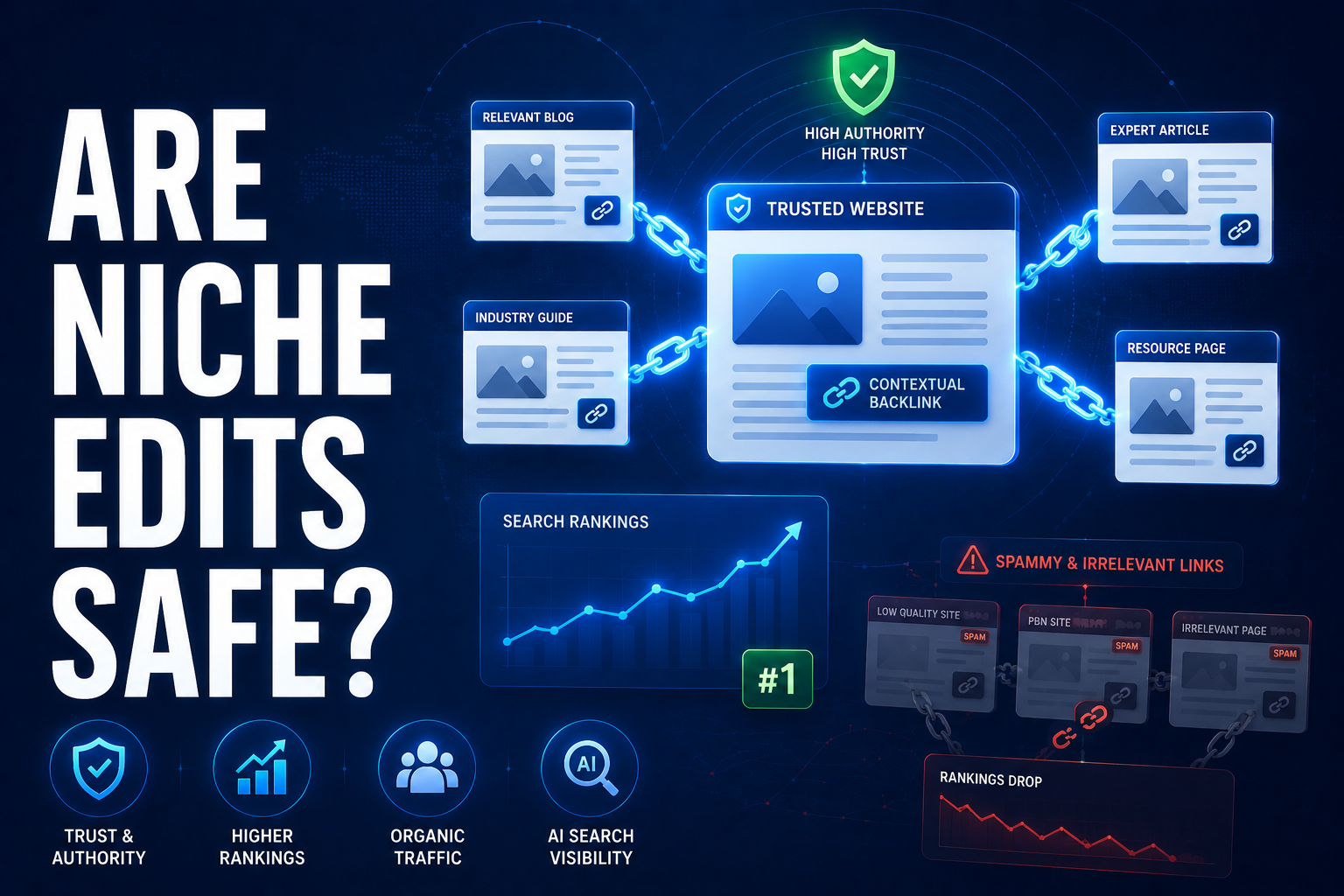
Rankings often drop after low-quality niche edit campaigns. That’s why many SEO professionals now ask: Are niche edits safe for SEO in 2026?
Google’s spam systems have become much better at detecting manipulative backlinks. Repeated anchor text, irrelevant placements, and cheap link networks now create stronger trust issues than they did a few years ago. Many older niche edit strategies stopped working after recent SpamBrain updates.
Despite those changes, SEO professionals still use niche edits to improve rankings, topical relevance, and contextual authority. The difference is that Google now rewards editorial quality, semantic relevance, and natural placement patterns instead of raw backlink volume.
This guide explains which niche edits still work in 2026 and which ones create SEO risks. You’ll learn how Google evaluates link insertions, what makes a placement safe or risky, common spam mistakes to avoid, and how niche edits compare with guest posts, digital PR, and other modern link-building strategies.
The Short Answer: Are Niche Edits Safe?
Yes, niche edits are safe in 2026 when they are placed naturally inside relevant, trusted content on real websites. Search engines now focus more on link context, topical relevance, and editorial trust than raw backlink numbers.
Google’s SpamBrain system evaluates signals like anchor diversity, link growth patterns, page relevance, and user engagement before assigning value to a backlink. A branded mention inside a cybersecurity guide looks natural. The same link placed on casino blogs, coupon sites, or AI-generated directories creates stronger spam signal.
A 2026 analysis of 239 niche edit backlinks found that 70% of pages improved rankings within 3 to 6 weeks after receiving high-quality editorial links. Low-quality links, however, are increasingly ignored through Google’s link neutralization systems instead of triggering direct penalties.
Safe niche edits usually share several qualities:
-
strong topical relevance
-
real organic traffic
-
natural anchor text
-
in-content placement
-
manual editorial review
For example, a fintech SaaS brand mentioned inside a budgeting guide appears far more trustworthy than a keyword-stuffed link inside unrelated travel content.
Pages with existing rankings and crawl history also pass signals faster because Google already visits them regularly. Manual outreach remains safer than automated marketplaces because it creates fewer detectable spam patterns.
Search engines now reward backlinks that add real value to the content. Links connected to original research, updated studies, useful tools, or expert resources often carry stronger trust signals than links pointing to thin commercial pages.
High-quality niche edits may also support visibility in AI-driven search systems like Google AI Overviews and Perplexity. These systems prioritize trusted entities, contextual authority, and semantically relevant citations.
Niche edits work best when they support a balanced backlink strategy that also includes digital PR, guest posts, branded mentions, and original content.
What Are Niche Edits in SEO?
Niche edits are SEO backlinks placed inside existing articles that already rank and receive traffic. Instead of creating new content, marketers add links to published pages on websites like SaaS blogs, industry publications, and online magazines.
Many SEO professionals also use terms like:
-
link insertions
-
curated links
-
contextual backlinks
Unlike guest posts, niche edits use pages that already have indexed history, backlinks, and keyword visibility. Since Google already crawls and trusts these pages, the links can sometimes influence rankings faster than links placed on brand-new articles.
For example, a project management software company may add a backlink inside a remote work productivity guide rather than publishing a separate guest post.
The process usually starts by finding a relevant article with real traffic and stable rankings. SEO teams then review metrics like keyword visibility, organic traffic, and topical relevance before contacting the website owner or editor for placement.
Strong niche edits blend naturally into the content instead of appearing as standalone promotional links. Search engines now analyze:
-
surrounding text
-
anchor placement
-
topical relevance
-
entity relationships
For example, a finance backlink inside an investing guide creates stronger semantic relevance than the same backlink placed inside travel content.
White-hat niche edits can also improve older pages by updating outdated information, replacing broken links, or adding newer references. For example, a healthcare SaaS company may replace old AI statistics with a newer industry study to improve content accuracy and user value.
Niche Edits vs Guest Posts
The main difference is that niche edits use existing pages, while guest posts require publishing new content. Guest posts provide full narrative control, while niche edits provide faster authority transfer from established pages.
| Feature | Niche Edits | Guest Posts |
| Content Type | Existing indexed pages | Newly written articles |
| Average Indexing Time | 3 to 7 days | 1 to 4 weeks |
| Content Creation | Minimal updates | Full article required |
| Authority Source | Existing page authority | New page authority |
| Typical Cost | $200–$600 | $350–$1,200+ |
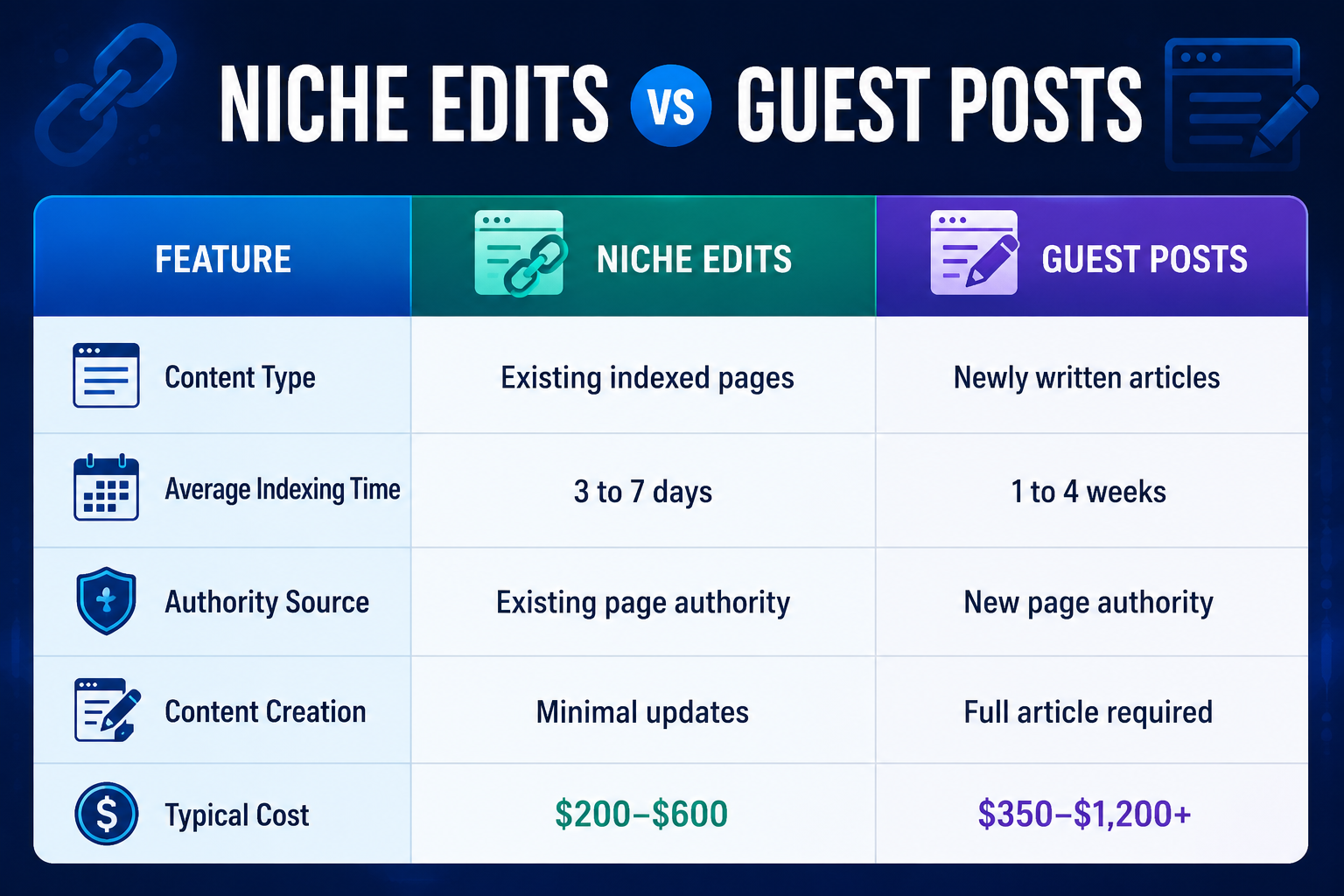
For example, a SaaS brand can place a contextual backlink inside a ranking CRM guide instead of publishing a new 2,000-word guest article.
Comparison of guest posts and niche edits with SEO benefits
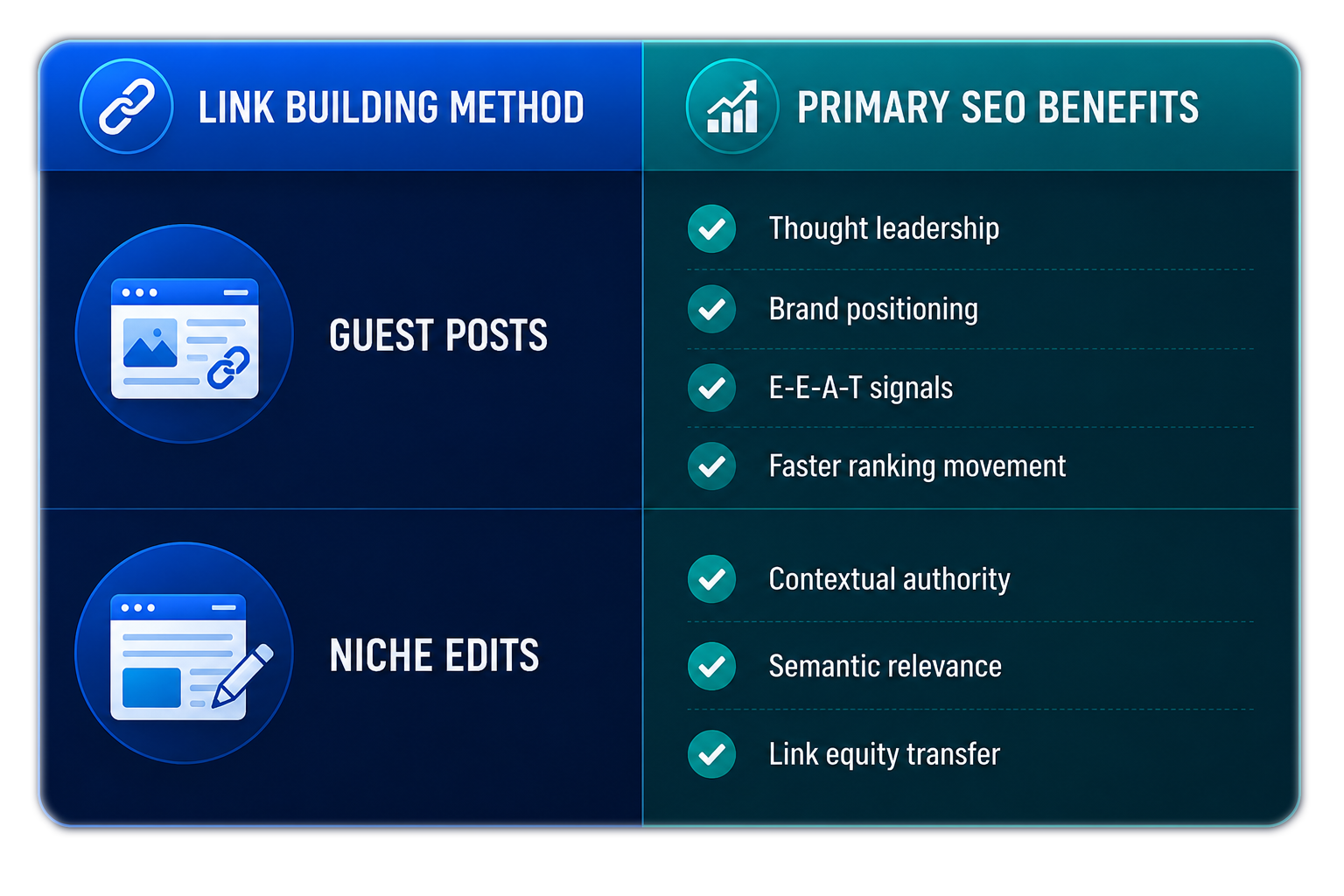
| Link Building Method | Primary SEO Benefits |
| Guest Posts |
• Thought leadership • Brand positioning • E-E-A-T signals |
| Niche Edits |
• Faster ranking movement • Contextual authority • Semantic relevance • Link equity transfer |
A 2026 service-quality analysis found that high-quality niche edits achieved 100% indexing rates on trusted websites with real traffic.
How Google Views Niche Edits
Google treats niche edits as acceptable when they appear as genuine editorial citations instead of manipulative ranking signals. Modern spam systems focus more on detecting unnatural backlink patterns than penalizing every paid link directly.
SpamBrain continuously analyzes factors like topical relevance, anchor diversity, outbound linking behavior, traffic quality, and link velocity. For example, a cybersecurity website earning backlinks from SaaS blogs, cloud security guides, and IT publications appears natural. Backlinks from gambling sites, crypto casinos, and payday lenders create stronger spam signals.
Google also warns against paid links that pass ranking signals without disclosure attributes like rel="nofollow" and rel="sponsored". These attributes help search engines identify whether a backlink is promotional or editorial.
Search engines also evaluate whether the backlink improves the content naturally. Editorial links usually support the article with useful resources, original research, or updated references.
Manipulative niche edits often create patterns like:
-
exact-match anchor overuse
-
bulk link placements
-
irrelevant referring domains
-
repetitive outbound linking
Modern NLP systems analyze the surrounding paragraph to determine whether the backlink fits naturally within the content. For example, a finance backlink inside an investing guide carries stronger semantic relevance than the same backlink inside pet care content.
Google has also shifted toward “link neutralization.” Instead of penalizing every suspicious backlink, search engines often ignore low-quality links completely. This may contribute to weaker rankings, lower visibility, and slower authority growth over time.
A 2026 service-quality analysis found that bulk low-quality niche edits produced almost no ranking improvements compared to trusted editorial placements.
High-quality niche edits perform best when they come from trusted websites with real traffic, strong topical relevance, and manual editorial oversight.
What Makes a Niche Edit Safe or Risky?
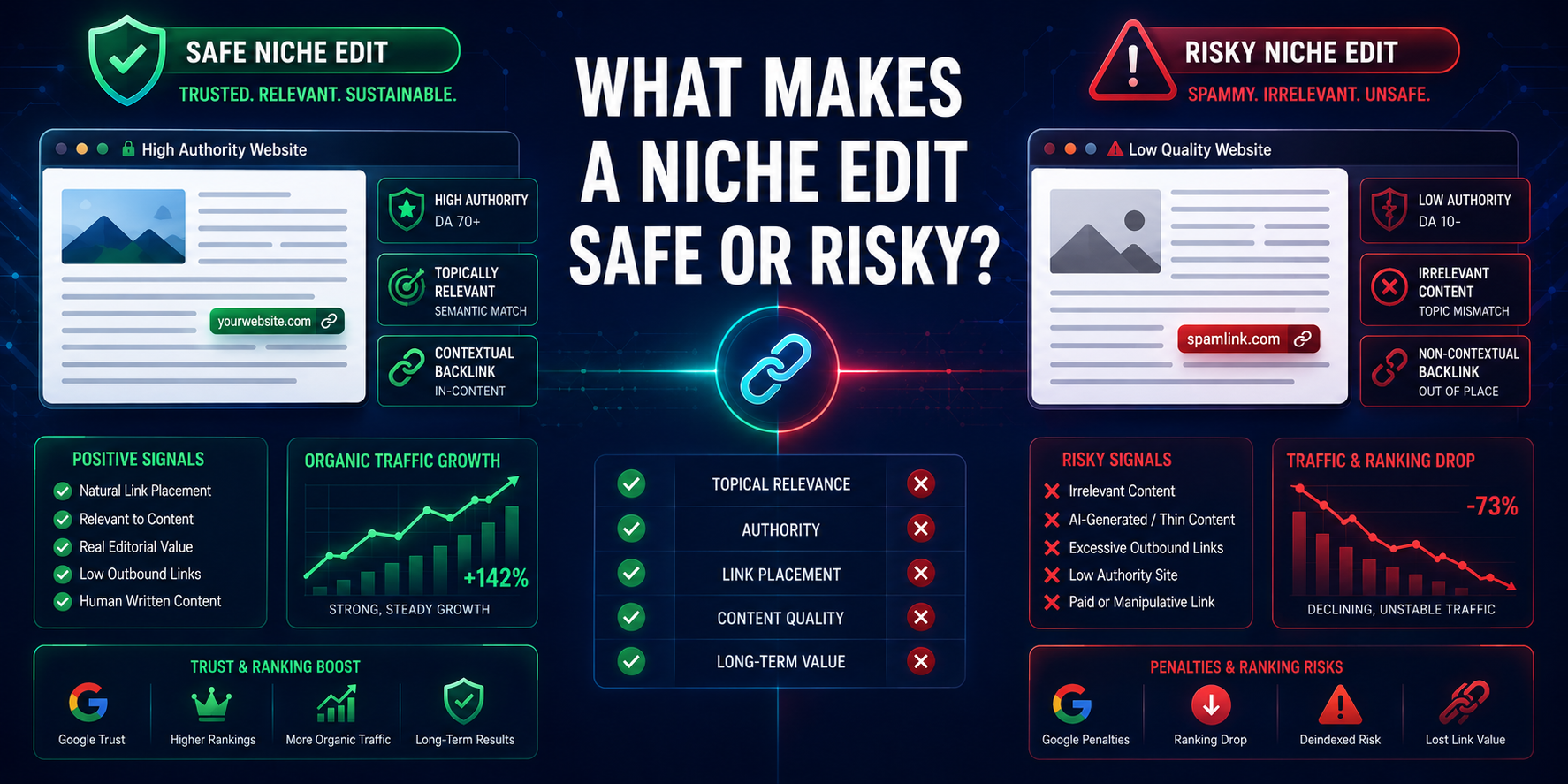
A niche edit becomes safe when it appears as a natural editorial reference on a trusted and topically relevant website. It becomes risky when the placement creates artificial linking patterns, weak semantic relevance, or spam indicators.
Google’s SpamBrain system now evaluates contextual trust, topical alignment, user engagement, and linking behavior instead of simply counting backlinks. This shift makes editorial quality far more important than raw link volume in modern SEO.
Safe Niche Edit Signals
Safe niche edits usually share several characteristics, including strong topical relevance, natural placement, real organic traffic, and editorial oversight. These links appear useful because they support the surrounding content naturally instead of interrupting it.
Contextual Relevance
For example, a cybersecurity backlink inside a ransomware prevention guide creates strong semantic alignment. The same backlink inside celebrity gossip content appears manipulative and contextually irrelevant.
Strong topical relevance also improves:
-
keyword association
-
entity trust
-
contextual authority
-
AI Overview visibility
Natural Placement and Editorial Trust
Placement quality matters as well. High-quality niche edits usually appear inside relevant paragraphs near supporting statistics, original research, or useful resources. A finance backlink inside an investing tutorial appears far more trustworthy than a footer link or author bio mention.
Trusted placements also tend to come from websites with:
-
real organic traffic
-
indexed keyword rankings
-
stable visibility
-
consistent engagement
Manual editorial reviews further strengthen trust because they reduce automated spam patterns and low-quality insertions.
A 2026 service-quality analysis found that trusted editorial niche edits achieved 100% indexing rates, while low-quality placements achieved only 40%.
Risky Niche Edit Signals
Risky niche edits usually create spam indicators, weak topical relevance, and detectable manipulation behavior. Common warning signs include anchor repetition, abnormal link velocity, irrelevant placements, and suspicious outbound linking structures.
Spammy and Irrelevant Placements
Spam-heavy websites create the highest risk because many exist mainly to sell links instead of helping users. Common indicators include AI-generated articles, thin content, fake traffic spikes, excessive outbound links, and unrelated niche categories.
For example, a recipe blog linking to payday lenders and crypto casinos creates a detectable spam footprint. Search engines can identify these relationships through network-level pattern analysis.
Irrelevant placements also weaken semantic trust. A healthcare SaaS backlink placed inside pet grooming content creates conflicting topical relationships that reduce authority transfer. Modern NLP systems now evaluate paragraph-level relevance instead of relying only on page-level relevance.
Paid Link Footprints
Paid link footprints create another major risk. Repeated anchor text, sudden backlink spikes, identical placement styles, and bulk marketplace links often signal scalable manipulation systems. For example, gaining 100 exact-match backlinks within a few days creates abnormal acquisition behavior that may trigger link neutralization.
Healthy backlink profiles usually contain a balanced mix of branded anchors, editorial mentions, guest posts, digital PR links, and partial-match anchors.
Safe niche edits strengthen topical trust, semantic relevance, and long-term authority, while risky niche edits create detectable manipulation patterns that lose value over time.
Key Risks Most People Ignore
Most niche edit risks come from backlink patterns that look manipulated to Google. SpamBrain now evaluates topical relevance, anchor usage, backlink growth, and trust signals instead of counting links alone.
One common mistake is overusing exact-match anchors. Repeating phrases like “best CRM software” across 50 backlinks creates unnatural linking patterns. Branded anchors like “HubSpot CRM” usually appear more natural because they match normal editorial behavior.
Research from 2026 recommended this safer anchor mix:
-
40% branded anchors
-
30% generic anchors
-
20% partial-match anchors
-
10% exact-match anchors
Google also analyzes surrounding text, semantic relevance, and user intent before passing value to a link. Excessive commercial anchors can weaken rankings and increase the chances of link neutralization.
Rapid backlink growth creates another major risk. For example, a SaaS startup gaining 120 niche edits within 14 days can trigger spam signals because the growth appears unnatural.
Established websites usually earn backlinks gradually through digital PR, branded mentions, content publishing, and organic citations. Research from 2026 found that established domains typically grow referring domains by only 5% to 14.5% monthly. Sudden spikes on newer domains often lead to crawl scrutiny and trust reduction.
Many SEO teams still rely too heavily on DR, DA, and TF scores. These are third-party metrics, not direct Google ranking signals. For example, a DR 80 website with zero traffic may provide less SEO value than a DR 35 blog with 20,000 monthly visitors.
Low-quality marketplaces often inflate metrics using expired domains, redirect schemes, traffic bots, and artificial backlinks. Google increasingly compares authority metrics against real traffic, indexed rankings, engagement quality, and topical relevance.
Technical footprints create additional warning signs. Shared hosting IPs, identical WordPress plugins, repeated outreach templates, and matching outbound link structures often indicate scalable manipulation systems.
For example, 30 websites using identical layouts and linking behavior create detectable network footprints. SpamBrain also reviews DNS relationships, hosting diversity, and editorial consistency across backlink ecosystems.
A 2026 service-quality analysis found that bulk low-quality niche edits produced almost no ranking improvements compared to trusted editorial placements.
Google now evaluates backlinks through trust signals, semantic relevance, and network-wide behavior instead of reviewing individual links in isolation.
Do Niche Edits Still Work for Rankings?
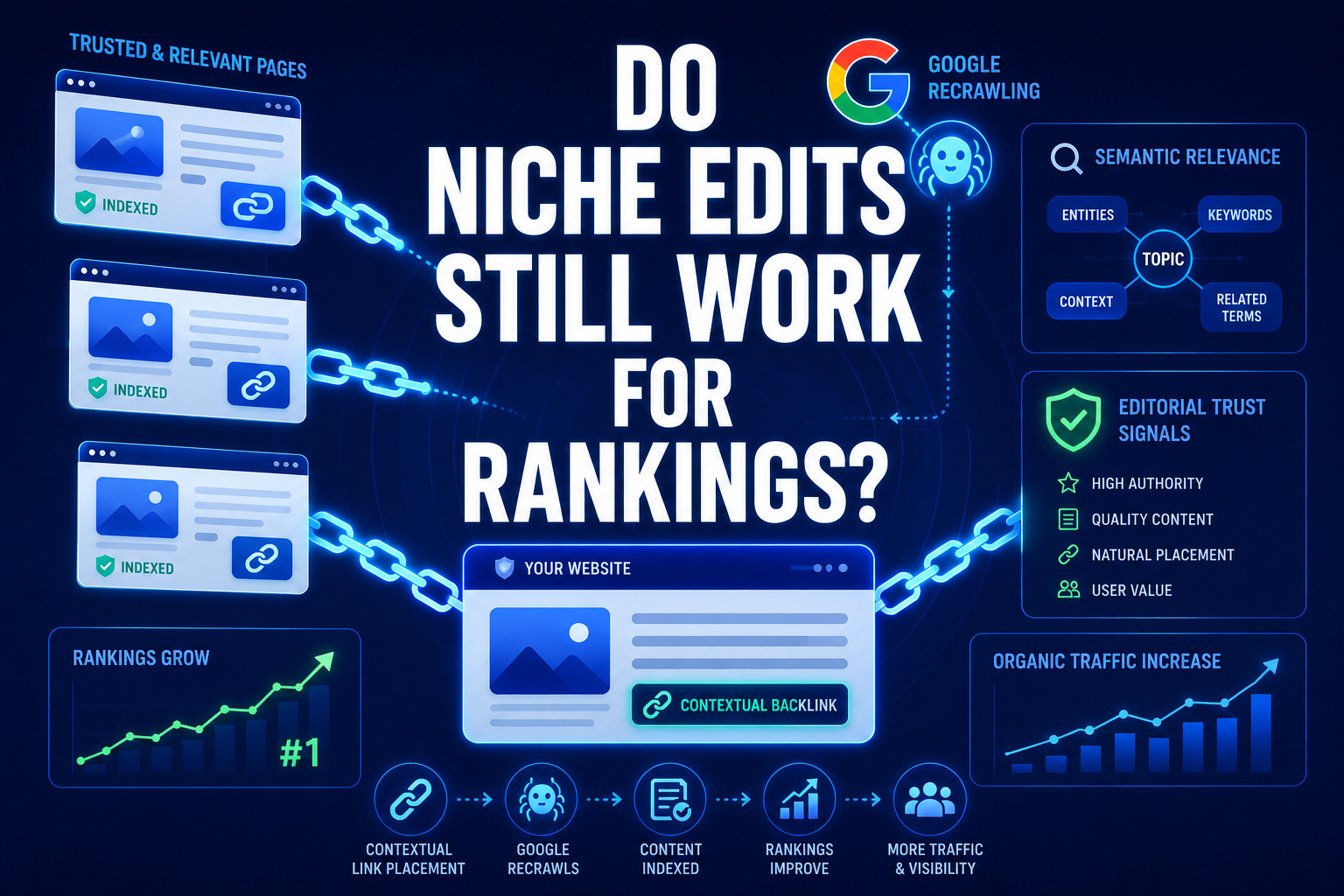
Yes, niche edits still work for rankings in 2026 when they come from relevant, trusted, and high-traffic pages. They work by passing authority from existing indexed content to the target page through contextual backlinks.
Niche edits often influence rankings faster than guest posts because the linking pages already have crawl history, backlinks, and keyword visibility. High-quality niche edits are commonly indexed within 3 to 7 days, while ranking improvements usually appear within 3 to 6 weeks.
A 2026 analysis of 239 niche edit backlinks found that 70% of pages improved rankings after receiving high-quality editorial links. Google evaluates the surrounding text, anchor placement, topical relevance, and editorial consistency before passing ranking value.
The process usually works in 4 steps:
-
Google recrawls the updated page.
-
Google detects the new contextual backlink.
-
SpamBrain evaluates semantic relevance and trust signals.
-
Google may pass authority to the destination page.
For example, a cybersecurity SaaS page receiving a backlink from a cloud security guide creates stronger topical relevance than a backlink from travel content.
Niche edits work best for:
-
competitive mid-funnel keywords
-
commercial landing pages
-
product comparison content
-
pages ranking between positions 5 and 15
However, niche edits often fail when they come from spam networks, irrelevant websites, trafficless domains, or manipulated backlink systems. A 2026 service-quality analysis found that bulk low-quality niche edits produced almost no ranking improvements compared to trusted editorial placements.
Google may also neutralize low-quality backlinks instead of penalizing them directly. Backlinks rarely improve rankings for pages with thin content, weak E-E-A-T signals, poor UX, or mismatched search intent.
Short-term gains usually come from faster indexing and authority transfer. Long-term impact depends on whether the linking page maintains rankings, traffic, and editorial trust over time.
In practice, niche edits still work when they strengthen topical authority, semantic relevance, and editorial trust instead of artificial backlink patterns.
When You Should Avoid Using Niche Edits
You should avoid niche edits when your website lacks authority, strong content, or a natural backlink profile. These links can strengthen existing trust signals, but they rarely build authority for weak or underdeveloped websites.
Low-Authority or New Websites
New websites carry higher risks because they lack historical trust and steady backlink growth. For example, a SaaS startup gaining 100 niche edits within 30 days creates abnormal acquisition signals for SpamBrain.
Research from 2026 found that established domains typically grow referring domains by only 5% to 14.5% monthly. Sharp backlink spikes on fresh domains often trigger trust reduction and link neutralization.
Weak or Thin Content
Poor content quality also limits results. Backlinks rarely improve rankings for pages with thin content, weak UX, low topical depth, or poor E-E-A-T signals.
For example, a finance landing page with 300 words and no original research will struggle even with authoritative backlinks. Google increasingly evaluates both content quality and backlink relevance together.
Overdependence on Paid Links
Relying too heavily on paid links creates additional risks. Websites built mostly on niche edits, sponsored placements, and PBNs often develop unnatural backlink profiles.
For example, a website where 80% of backlinks come from paid insertions sends stronger manipulation signals than a diversified profile.
Niche edits work best when they support strong content, natural authority growth, and diversified backlink strategies.
Conclusion
In conclusion, niche edits are still safe for SEO in 2026 when they come from trusted, relevant, and editorially managed websites. Google now prioritizes contextual relevance, natural placement, semantic trust, and user value over raw backlink volume.
High-quality niche edits can improve rankings, topical authority, and crawl visibility faster than many traditional link-building methods. In contrast, spam networks, over-optimized anchors, irrelevant placements, and rapid backlink spikes often weaken trust and reduce SEO value.
The safest strategy is to combine niche edits with digital PR, guest posts, branded mentions, and strong content. Real traffic, topical relevance, natural anchors, and editorial oversight now matter far more than inflated authority metrics or bulk placements.
If you use niche edits in 2026, focus on quality and long-term trust instead of scalable link schemes. That approach is more likely to support stable rankings, stronger authority, and sustainable organic growth.
Stay Ahead in Digital Marketing
Get exclusive insights, trends, and strategies delivered straight to your inbox. Subscribe now!
Web Genie
Driving Digital Growth with Innovation & Strategy
Quick Links
Contact Info
- info@webgenie.io
- +44 7472 732550
- Office 1009 85 Dunstall Hill, Wolverhampton, United Kingdom, WV6 0SR
Social Media
© 2025 Web Genie, All Rights Reserved.