How AI Overview Will Change SEO in 2026: The Future of Google Search Optimization
Home / Blog
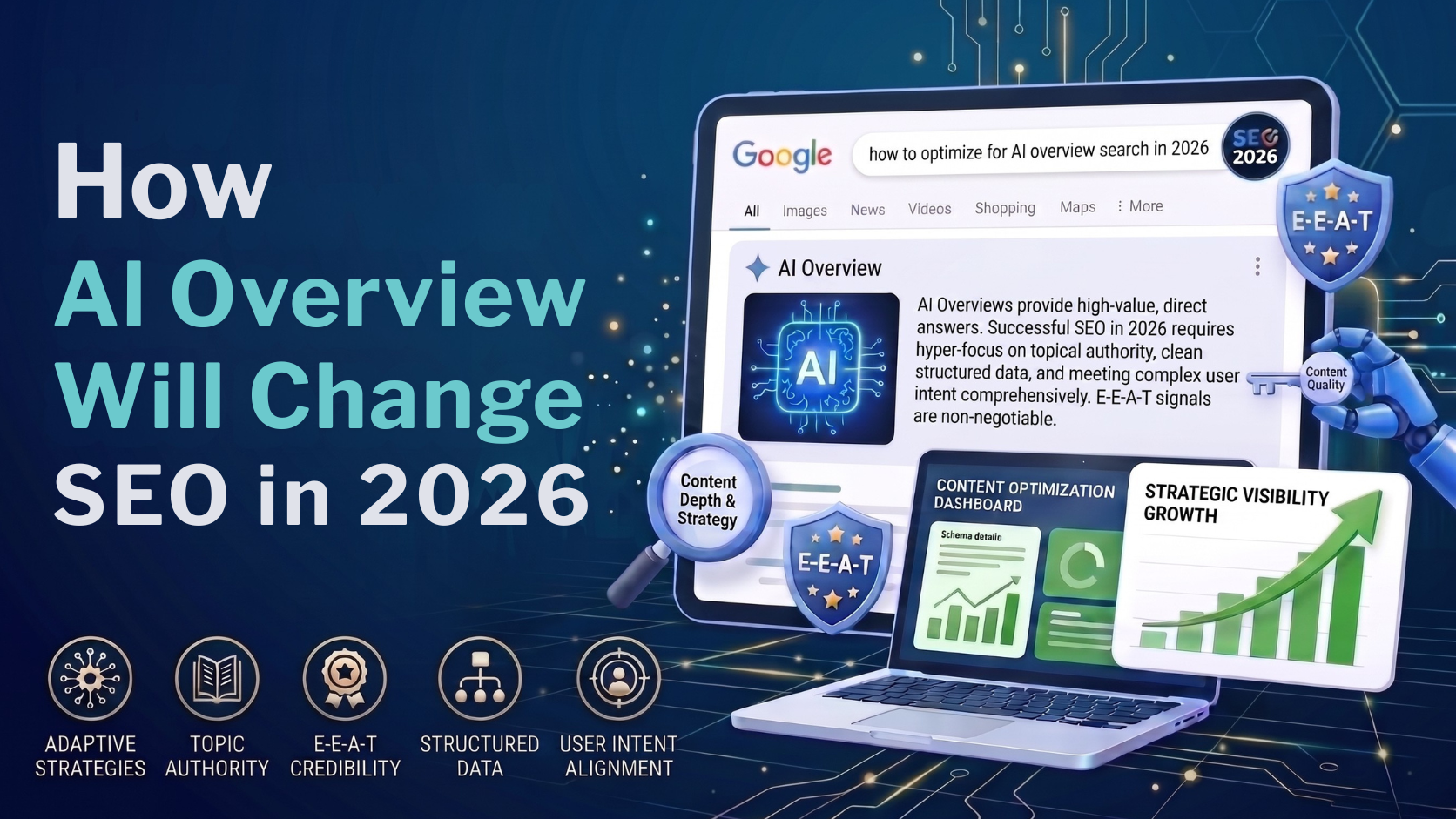
AI Overviews are changing how Google search results appear and how users find information online. This AI-powered feature creates quick summaries by gathering information from multiple sources and showing answers directly on the search page.
This shift matters because SEO now involves more than traditional rankings and clicks. SEO professionals, marketers, and website owners need to understand how AI Overviews, search visibility, AI citations, organic traffic, CTR, and content quality affect online performance. Successful AI search optimization depends on clear answers, helpful content, structured information, and strong topical relevance.
This article explains how AI Overview will change SEO in 2026. It covers how AI Overviews work, their impact on Google Search optimization, the SEO strategies that require updates, and the steps businesses can take to prepare for AI-powered search experiences.
What Are Google AI Overviews and Why Do They Matter?
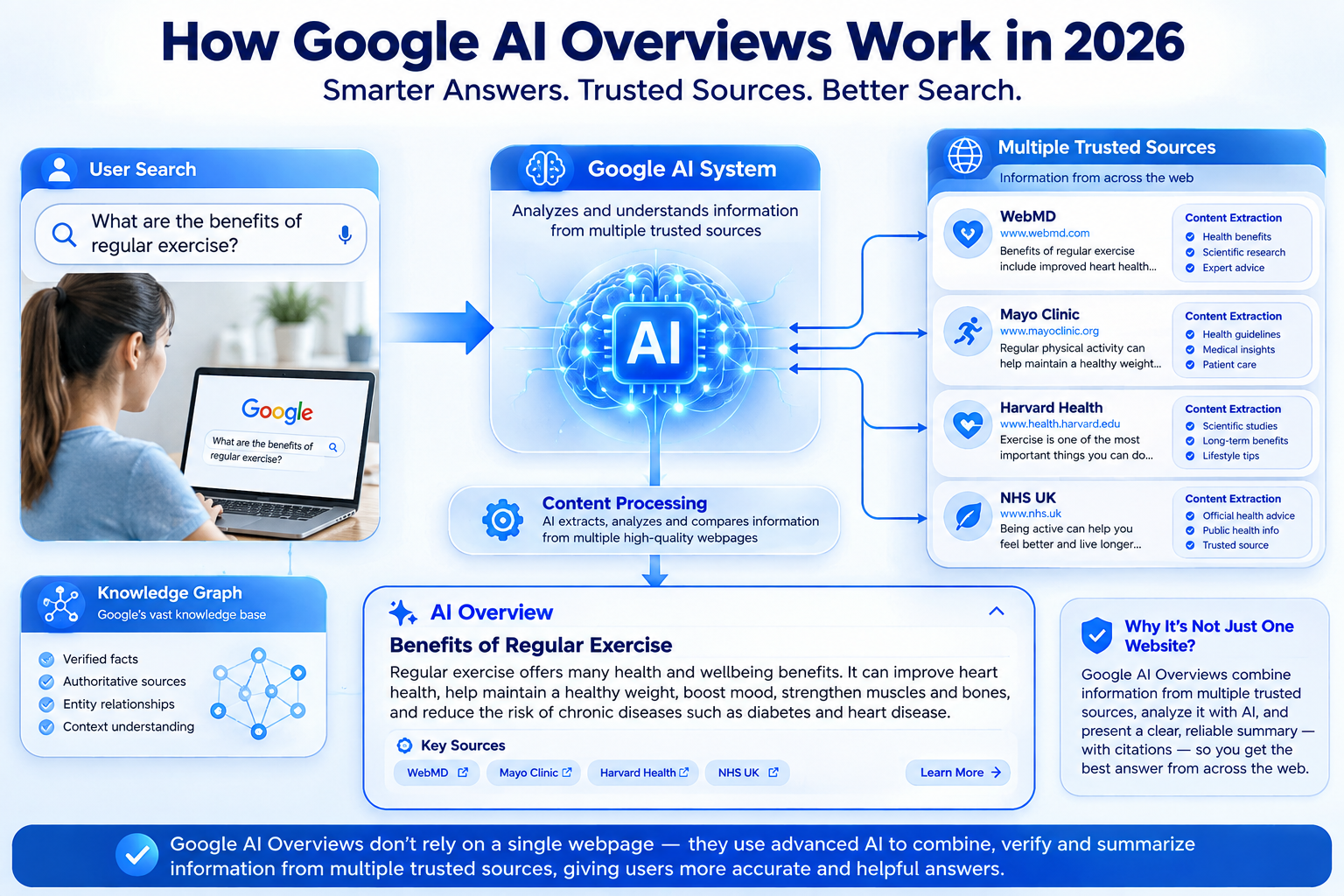
Google AI Overviews are AI-generated summaries that answer search queries by combining information from multiple web sources. They appear near the top of Google Search results, often above traditional organic listings.
Powered by Gemini models and Search technologies, Google AI Overviews use retrieval-augmented generation (RAG) to collect information from multiple pages. The system then creates a summarized response instead of focusing on a single ranking page.
The importance of AI Overviews comes from a shift in search visibility. Websites now need to earn citations inside AI-generated answers, not only rank in the top organic positions. Google requires pages to be indexed and eligible for standard Search results before they can become potential AI Overview sources.
AI Overviews are particularly valuable for information-focused searches, including:
-
Health topics such as symptoms, treatments, and medical conditions from sources like WebMD, Mayo Clinic, and Healthline.
-
B2B software research such as comparisons, reviews, and feature analysis from platforms like G2, Capterra, and vendor websites.
-
Educational topics such as definitions and explanations from sources like Khan Academy and Britannica.
Recent industry studies show AI Overviews appearing across a significant share of tracked searches, especially for complex informational queries. Some analyses have found that AI Overview citations can include pages outside Google's top 10 organic results.
As a result, traditional rankings and AI citation visibility are becoming separate SEO goals. Websites need strong technical SEO, helpful content, clear information structures, and topical authority to compete in both search environments.
I kept the factual meaning, SEO entities, examples, and statistics unchanged while making the flow more natural and reducing AI-style wording.
How AI Overviews Will Change SEO in 2026
AI Overviews will change SEO by making AI citation visibility a new optimization goal alongside traditional rankings. SEO professionals will need to focus on clicks, citations, content structure, experience signals, and brand authority.
AI Will Change How Users Click Search Results
AI Overviews can reduce organic clicks by showing answers directly within search results. The impact depends on query type, search intent, and user behavior.
Informational searches such as "what is," "how does," and "why does" are more likely to lose clicks because users can find basic answers without visiting websites.
By comparison, transactional searches such as "buy," "price," and "sign up" often maintain stronger website visits because users still need products, services, or specific actions.
On mobile devices, AI Overviews can move traditional listings below the first screen view. As a result, appearing inside the AI-generated answer is becoming increasingly important.
SEO Rankings Will Become Less Important Than AI Visibility
A high Google ranking does not guarantee that a page will appear in an AI Overview. AI citations can come from pages outside the top organic results when those pages provide useful and specific answers.
Traditional ranking systems and AI systems evaluate content differently. Clear answers, structured information, and strong topical relevance help AI systems understand and retrieve information.
SEO now requires two separate goals: ranking in search results and earning visibility inside AI-generated answers.
Content Structure Will Influence AI Citations
AI systems extract specific information from pages, which makes clear content structure more important. Pages with descriptive headings, short sections, direct answers, and useful formatting are easier for search systems to interpret.
Structured data can help search engines understand page information, entities, and relationships. However, schema markup alone does not guarantee AI Overview visibility.
Content formats that support information extraction include:
-
Direct definitions
-
Comparison tables
-
Step-by-step instructions
-
Original research
-
Expert explanations
Experience-Based Content Will Gain More Value
Firsthand experience will become more valuable because AI can quickly summarize general information. Original testing, case studies, screenshots, and expert insights provide unique information that is difficult to replicate.
Google's E-E-A-T framework emphasizes:
-
Experience
-
Expertise
-
Authoritativeness
-
Trustworthiness
Content created from real-world experience can provide stronger trust signals than rewritten summaries.
Brand Authority Will Become a Stronger Ranking Signal
Strong brand signals can improve visibility in AI-generated answers because AI systems rely on trustworthy sources. Consistent information across the web helps search engines understand:
-
Who created the content
-
What topics the brand covers
-
Whether external sources recognize the brand
Important signals include:
-
Accurate business information
-
Author profiles with credentials
-
Industry mentions
-
Reliable external references
AI Overview optimization will not replace traditional SEO. Instead, it will expand SEO by adding a new objective: becoming a trusted source that AI systems choose to cite.
How SEO Professionals Should Adapt Their Strategy
SEO professionals should adapt their strategies by improving content quality, entity signals, structured data, topical authority, and first-hand experience. These areas help websites increase visibility across traditional search results and AI-generated answers.
Start with direct answers when creating content. Major sections should begin with clear statements that immediately address search intent. Examples, evidence, and additional context can then support these answers and provide deeper value.
Build stronger entity signals across trusted sources. Keep brand information consistent across relevant databases, authoritative websites, and industry platforms. Digital PR campaigns can help earn relevant mentions from trusted publications and communities.
Use structured data that matches each page's purpose. Apply JSON-LD schema types such as Article, Product, FAQPage, or HowTo only when they accurately represent visible content. Structured data helps search engines understand page information, entities, and relationships.
Create topical authority through connected content clusters. Instead of publishing isolated keyword pages, build hub-and-spoke structures that cover related subtopics. For example, an email marketing hub can connect to automation, deliverability, segmentation, and analytics pages.
Add first-hand experience to important content assets. Original research, expert commentary, screenshots, product testing, and documented case studies can provide unique value. Author credibility should also be supported with detailed profiles and relevant professional references.
Measure AI visibility separately from traditional rankings. Track AI citations, brand mentions, referral traffic, and entity visibility alongside keyword positions. AI search performance requires additional measurement beyond standard rank tracking.
Traditional SEO vs AI SEO: What Changes?
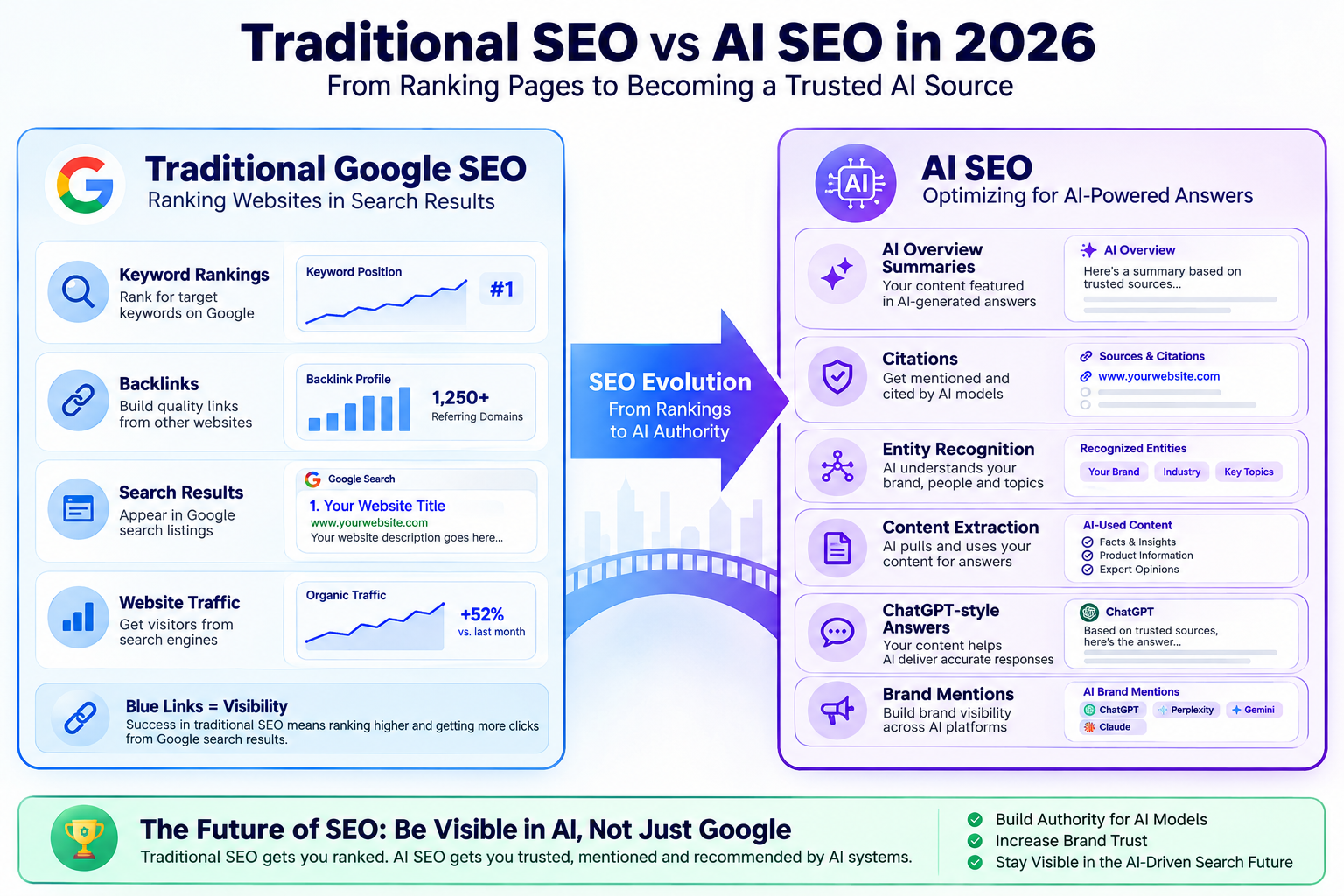
Traditional SEO focuses on improving rankings and earning organic clicks, while AI SEO focuses on gaining visibility inside AI-generated answers through citations, mentions, and recommendations. Both approaches depend on strong technical foundations, but their optimization methods and success measurements are different.
|
Strategic Vector |
Traditional SEO |
AI SEO / GEO |
|
Primary objective |
Earn rankings and organic clicks |
Earn visibility through citations, mentions, and AI recommendations |
|
Discovery surface |
Blue links, featured snippets, local results |
AI Overviews, ChatGPT Search, Perplexity, Gemini, and AI answer engines |
|
Core mechanism |
Technical SEO, content relevance, links, and authority signals |
Retrieval systems, entity understanding, content extraction, and relevance signals |
|
Success metric |
Rankings, organic traffic, CTR, conversions |
Citations, brand mentions, AI referral traffic, recommendation visibility |
|
Content style |
Comprehensive content built around search intent |
Answer-first sections, structured information, and extractable content blocks |
|
Query intent |
Keyword-based searches with specific intent |
Conversational prompts containing multiple related requirements |
|
Off-page focus |
Relevant backlinks, authority, and digital relationships |
Brand mentions, entity associations, and digital PR |
|
User journey |
Search, click, explore, convert |
Read AI answer, explore sources, visit brand, or convert later |
AI SEO does not replace traditional SEO. It builds on the same technical foundation that supports search visibility. Google requires AI Overview sources to come from pages that are already indexed and eligible for normal Search visibility.
The biggest change appears in content execution. Teams creating product pages, comparison guides, and tutorials are increasingly structuring sections around direct answers, supporting evidence, and clear information hierarchy.
Because AI visibility requires different measurements, SEO platforms now provide separate reporting for organic rankings and AI visibility signals. Traditional rank tracking alone does not provide a complete view of search performance.
How To Optimize Content For Google AI Overviews
Optimizing content for Google AI Overviews requires improving answer clarity, structure, originality, examples, and author credibility. These practices help AI systems understand, retrieve, and summarize information more effectively.
Step 1: Answer Questions Clearly
Every major section should start with a direct answer that matches the search intent. Provide the main answer first, then add supporting details, examples, and additional context.
Long introductions that delay the key information should be avoided. Users and AI systems both benefit from content that provides the solution quickly.
For example, instead of explaining the history of enterprise security first, state directly that enterprise cloud security depends on 3 controls: encryption standards, identity access management, and real-time threat monitoring.
Step 2: Use Structured Headings
Clear headings help AI systems connect content with specific information needs. Use natural question-based headings that reflect how users search for answers.
When AI systems process complex queries, they may identify related subtopics to build a complete response. Pages with organized H2s and H3s can cover multiple connected questions more effectively.
Avoid unclear headings such as "Overview" or "More Details." Use descriptive headings that explain the purpose of each section.
Step 3: Add Original Insights
Original research and first-hand information make content more valuable than general summaries. Include proprietary data, internal analysis, expert commentary, customer insights, and original case studies.
Information from sources such as customer surveys, testing results, analytics data, and documented experiences can provide unique details that competitors may not have.
Step 4: Include Practical Examples
Specific examples help both readers and AI systems understand complex concepts. Use comparison tables, step-by-step processes, case studies, screenshots, and structured lists where they support the topic.
Tables should include clear headings, defined metrics, and specific information instead of broad or unclear descriptions.
Step 5: Strengthen Author Signals
Clear author information helps demonstrate expertise and improve content credibility. Add detailed author bios that include relevant experience, qualifications, and professional background.
Author profiles and structured data can help search engines understand author entities and their relationships when used correctly.
Real Examples of AI Overview-Friendly Content
AI Overview-friendly content usually follows structured formats that match the page type and search intent. A product review needs different information compared with a local service page. The examples below cover 4 common content formats.
Product Reviews
Product review pages perform better when they combine first-hand experience with structured testing information. Start with a summary that explains the product's strengths, limitations, ideal users, and key findings.
Use comparison tables that include measurable criteria such as features, pricing, performance, and usability. Explain testing methods whenever possible to show how conclusions were reached.
Reviews of tools like project management software, laptops, or CRM platforms should include clear pros and cons. Finish with buyer recommendations that explain who should choose or avoid the product.
How-To Guides
How-to guides work best when instructions are clear, sequential, and easy to follow. Begin with prerequisites such as required tools, software versions, permissions, and estimated completion time.
Each step should start with a clear action verb such as install, configure, or verify. Include expected results and troubleshooting guidance for situations where users may face problems.
Guides covering tasks like setting up email automation, installing a CMS plugin, or configuring a firewall should provide exact instructions instead of general explanations.
Comparison Pages
Comparison pages need clear differences, measurable data, and recommendations focused on user decisions. Start by explaining the main difference between the options being compared.
Tables should include specific metrics instead of unclear descriptions such as "better" or "faster." Include details such as pricing, features, limitations, ideal users, and use cases.
Comparison pages covering options like Shopify vs WooCommerce or HubSpot vs Salesforce should end with decision guidance. Explain which option fits specific business needs and situations.
Local Service Pages
Local service pages need accurate location details, service information, trust signals, and pricing transparency. Include service areas, response information, licenses, certifications, and relevant business credentials.
Service providers like plumbers, electricians, or HVAC contractors should present pricing information clearly when available. Tables showing diagnostic fees, common services, and cost ranges help users understand expected costs.
Detailed service pages provide clearer information for users and search systems compared with generic service descriptions.
No, AI Overviews will not replace SEO. They expand SEO by adding new visibility goals. Traditional SEO remains important because AI features depend on pages that are already discoverable, indexed, and eligible for Search visibility.
Search traffic is not disappearing across all queries. Instead, user behavior is becoming more selective. Informational queries may see larger click changes because AI Overviews can provide direct summaries. Commercial and transactional searches often maintain stronger website visits because users still need products, services, and specific actions.
Clicks from AI-generated answers can come from highly informed users. A person who reads an AI summary and visits a cited source has already received initial information before reaching the website.
The two systems work together rather than competing with each other. AI SEO builds on technical SEO, content quality, structured information, internal linking, and strong user experience. A page needs a reliable SEO foundation before it can become a trusted AI information source.
SEO's role is expanding rather than shrinking. Modern search optimization now includes organic rankings, AI visibility, and stronger brand and entity signals. Teams that track only rankings may miss important changes in how users discover, evaluate, and interact with websites.
FAQs
What are Google AI Overviews?
Google AI Overviews are AI-generated summaries that provide answers directly within Google Search results. They combine information from multiple web sources and include citation links that allow users to explore supporting pages.
Do AI Overviews reduce website traffic?
AI Overviews can reduce clicks for some informational searches because users receive answers directly in search results. The impact depends on query type, search intent, and industry.
Does ranking #1 guarantee inclusion in an AI Overview?
No, ranking first does not guarantee an AI Overview citation. AI systems evaluate factors such as relevance, content clarity, authority, and how effectively a page answers specific information needs.
How do I get my content cited in AI Overviews?
Create content that provides clear answers, strong evidence, and well-structured information. Use descriptive headings, original insights, examples, and accurate structured data where appropriate.
Does schema markup help with AI Overview visibility?
Structured data can help search engines understand page content, entities, and relationships. However, schema markup alone does not guarantee AI Overview inclusion.
Are AI Overviews the same as featured snippets?
No, AI Overviews and featured snippets work differently. Featured snippets usually extract an answer from a single page, while AI Overviews create summaries using information from multiple sources.
Can I opt out of appearing in AI Overviews?
Website owners can use snippet controls such as nosnippet and max-snippet to limit how Google displays content previews. These settings may also affect eligibility for some search features.
Is AI-generated content penalized in AI Overview citations?
Google does not automatically penalize content because AI tools were used during creation. Content quality, accuracy, originality, and usefulness remain the key factors.
What tools track AI Overview visibility?
SEO platforms now provide AI visibility reports that track citations, mentions, and brand presence across AI-generated answers. These measurements complement traditional ranking and traffic reports.
Final Recommendation
In conclusion, How AI Overview Will Change SEO is an important topic as Google Search continues to change in 2026. AI Overviews will not replace SEO. They will change how websites appear and gain visibility in search results. Businesses will need to focus on both Google rankings and AI citations by creating content that AI systems can understand and reference.
A successful SEO strategy will still require technical SEO, backlinks, internal links, and a strong user experience. Websites should also improve their content by adding clear answers, expert insights, and real examples that provide more value to users.
Content should follow an answer-first approach by giving direct answers before adding more details. Original research, customer experiences, expert opinions, and practical examples will become more valuable because they offer unique information that AI systems cannot easily reproduce.
SEO performance will also be measured in new ways. Rankings and website traffic will remain important, but AI citations, brand mentions, and AI referral traffic will help show how visible a business is across different search experiences.
The future of SEO is not about choosing between Google Search and AI search. Businesses need helpful, clear, and trustworthy content that works across both platforms. Start improving your SEO strategy today by creating content that ranks well, builds trust, and provides useful answers for your audience.
Stay Ahead in Digital Marketing
Get exclusive insights, trends, and strategies delivered straight to your inbox. Subscribe now!
Web Genie
Driving Digital Growth with Innovation & Strategy
Quick Links
Contact Info
- info@webgenie.io
- +44 7472 732550
- Office 1009 85 Dunstall Hill, Wolverhampton, United Kingdom, WV6 0SR
Social Media
© 2025 Web Genie, All Rights Reserved.