Is SEO Part of Web Development? Understanding the Connection
Home / Blog
A website can look impressive but still struggle to attract visitors without proper SEO. Many businesses invest in web development while overlooking search visibility during the building process. As a result, they often ask, "Is SEO Part of Web Development?" when their website does not appear well on Google.
SEO and web development have different roles, but both areas support website success. Development choices influence key SEO factors, including page speed, mobile performance, website structure, and search engine accessibility. By considering SEO during development, businesses can build websites that perform better and reach more potential users.
This article explains the connection between SEO and web development. You will learn how technical SEO works, which tasks developers manage, and why combining both skills helps create stronger websites.
What Is the Difference Between SEO and Web Development?
SEO helps a website appear in search results, while web development builds the website and makes it function properly.
SEO helps users find websites through search engines, like Google and Bing. It includes methods such as keyword research, content improvement, and link building. For example, SEO experts may target keywords like “real estate SEO services” and “local SEO agency” to reach relevant audiences.
Web development involves creating websites through coding and technical systems. Developers use programming languages, like HTML, CSS, and JavaScript, to build website features. They also work with databases, like MySQL and MongoDB, and frameworks, like React and Laravel.
The main difference is the goal of each field. SEO focuses on increasing visitors from search engines. Web development focuses on creating useful websites, like ecommerce stores, business websites, and web applications.
SEO professionals improve search elements, like title tags, meta descriptions, internal links, and website content. Developers improve technical elements, like page speed, website structure, security, and mobile responsiveness.
For example, developers improve page loading speed through technical changes. SEO experts optimize those pages so users can find them through relevant searches. Google reports that 53% of mobile visitors leave a website when a page takes more than 3 seconds to load. This shows that website speed can influence user experience and SEO performance.
|
SEO |
Web Development |
|
Helps websites appear in search results |
Builds website pages and features |
|
Uses methods like keyword research and content optimization |
Uses technologies like coding languages and frameworks |
|
Focuses on increasing visitors from search engines |
Focuses on creating functional websites |
|
Measures results through rankings, clicks, and impressions |
Measures results through speed, security, and usability |
A successful website requires both SEO and web development. SEO helps people discover the website through search engines. Web development ensures the website works properly and provides a smooth user experience.
Is SEO Part of Web Development?
SEO is not a main part of web development, but technical SEO is connected to how websites are built. Web development focuses on creating websites through code. SEO focuses on helping websites appear in search results and attract more visitors.
Web developers create the basic structure of a website. They build pages, add features, connect databases, and improve website speed. SEO experts focus on keywords, content strategies, and optimization methods that help people find websites through search engines.
SEO and web development overlap in several areas. Developers improve technical parts that help search engines crawl and understand websites, such as:
|
SEO Area |
Development Role |
|
Page speed |
Developers improve loading speed through code improvements, smaller file sizes, and caching methods. |
|
Mobile SEO |
Developers create websites that work properly on phones, tablets, and computers. |
|
Website structure |
Developers create clear URLs, simple navigation, and organized page layouts. |
|
Technical SEO |
Developers add tools like XML sitemaps, robots.txt files, and schema markup. |
|
Website security |
Developers protect websites through HTTPS and secure coding practices. |
Technical improvements can influence SEO because search engines consider user experience factors. Google uses Core Web Vitals to measure important areas, including loading speed, website interaction, and visual stability.
SEO also includes tasks beyond website development. SEO experts handle content creation, keyword research, competitor analysis, and methods that improve website trust. Developers usually solve technical problems, while SEO experts create plans to improve search visibility.
Both fields should work together during the website creation process. Developers build a strong technical foundation, and SEO experts improve the website’s ability to reach the right audience.
A website with strong development but no SEO may struggle to attract visitors. A website with effective SEO but weak development may provide a poor user experience. Combining both creates a website that is faster, easier to use, and easier for search engines to understand.
How Web Development Affects SEO Performance
Web development affects SEO performance by improving technical areas that help search engines access and understand websites.
The way a website is developed affects SEO factors, like page speed, mobile usability, website structure, and crawlability. Technical problems, like slow pages or blocked access, can lower search visibility. Good development practices create a strong base for SEO success.
Website Speed
Website speed affects SEO because faster pages improve user experience and reduce loading delays.
Developers improve website speed through methods like image compression, code optimization, and browser caching. Slow websites can cause users to leave pages quickly and reduce engagement.
Google reports that 53% of mobile users leave pages that take longer than 3 seconds to load.
For example, developers optimize website files, like product images, JavaScript files, and CSS files, to improve loading speed.
Mobile Responsiveness
Mobile responsiveness improves SEO by ensuring websites work properly on smartphones, tablets, and computers.
Google uses mobile-first indexing, which means it mainly uses the mobile version of a website for ranking and indexing.
Responsive designs, like flexible layouts, adjustable images, and mobile-friendly menus, help users access content on different screen sizes. Developers create these features to improve the mobile experience.
Clean Website Architecture
Clean website architecture improves SEO by making website structures easier for search engines to understand.
Developers organize websites with logical folders, clear navigation, and connected pages. These structures help search crawlers find important content.
For example, ecommerce websites organize categories, like shoes, clothing, and accessories, with clear internal links between related pages.
SEO-Friendly URL Structure
SEO-friendly URLs help users and search engines understand website pages.
Developers create clear URLs, like example.com/services/seo-services and example.com/blog/seo-guide. These URLs explain page topics better than addresses with random characters.
Clear URLs support website sections, like service pages, product pages, and blog articles, by showing their purpose.
Schema Markup
Schema markup helps search engines understand website information more accurately.
Developers add structured data types, like Product schema, Review schema, and FAQ schema. These formats help search engines create rich results.
For example, schema markup can display details, like star ratings, prices, and event information, in search results.
Crawlability
Crawlability affects SEO because search engines need access to pages before ranking them.
Developers improve crawlability through technical elements, like XML sitemaps, robots.txt files, and internal links. These elements guide search engines through website content.
Blocked pages or broken links can stop search engines from discovering important pages.
Indexing
Indexing affects SEO because search engines store website pages before displaying them in search results.
Developers support indexing through methods like clean code, canonical tags, and correct page status codes.
For example, developers use HTTP status codes, like 200 for successful pages, 301 for redirects, and 404 for missing pages.
Web development provides the technical foundation that supports SEO strategies. A well-built website helps search engines access content and gives users a better experience.

Which SEO Tasks Are Handled by SEO Specialists?
SEO specialists handle tasks like keyword research, content optimization, link building, and competitor analysis to improve website visibility.
Keyword research helps SEO specialists discover the terms people use on Google and other search engines. They analyze keywords, like “web development services,” “SEO agency near me,” and “website design company,” to identify ranking opportunities.
Content optimization improves website pages for both users and search engines. Specialists update elements, like headings, page titles, meta descriptions, and image alt text. They also improve pages, like service pages, blogs, and landing pages, to match search intent.
Link building helps increase website authority through external references. SEO specialists earn backlinks, like links from industry websites, news platforms, and professional directories. These links help search engines understand website authority and relevance.
Competitor analysis allows SEO specialists to identify opportunities for better search performance. They review competitor data, like ranking keywords, content strategies, backlink profiles, and website structures.
Technical audits help SEO specialists find website issues that may affect search performance. They use tools, like Google Search Console, Google Analytics, and Semrush, to track rankings, traffic, and technical problems. Google processes billions of searches every day, which shows the importance of search visibility.
Continuous optimization helps SEO specialists improve organic growth over time. They work with developers when technical updates are needed. Their efforts help websites achieve stronger rankings, attract relevant visitors, and provide a better user experience.
SEO vs Web Development: Who Handles What?
SEO specialists improve website visibility and search performance, while web developers build and maintain the technical foundation of websites.
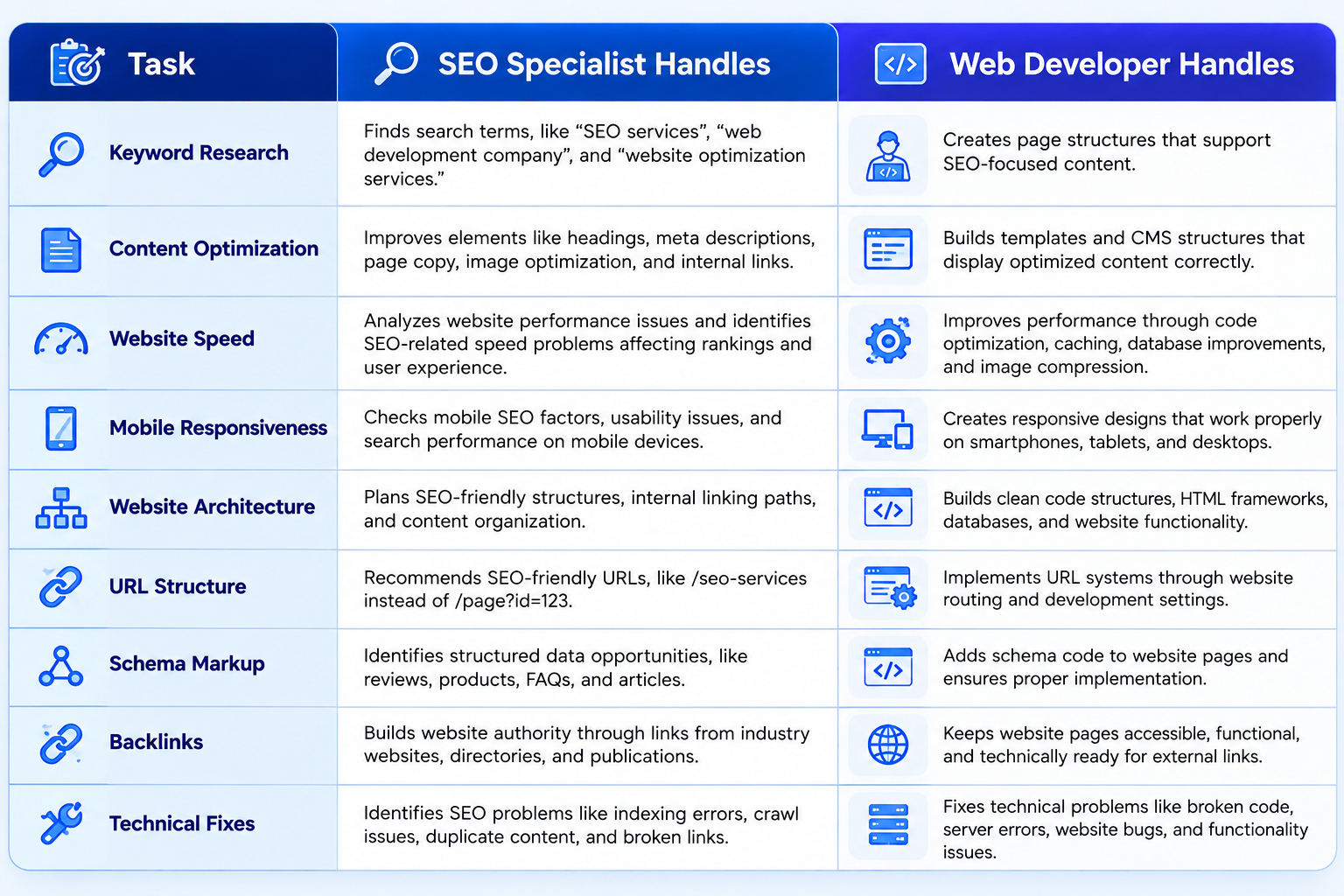
SEO and web development focus on different areas. SEO specialists work on rankings, organic traffic, content performance, and search visibility. Web developers handle website structure, coding, functionality, and technical improvements.
|
Task |
SEO Specialist Handles |
Web Developer Handles |
|
Keyword Research |
Finds search terms, like “SEO services,” “web development company,” and “website optimization services.” |
Creates page structures that support SEO-focused content. |
|
Content Optimization |
Improves elements like headings, meta descriptions, page copy, image optimization, and internal links. |
Builds templates and CMS structures that display optimized content correctly. |
|
Website Speed |
Analyzes website performance issues and identifies SEO-related speed problems affecting rankings and user experience. |
Improves performance through code optimization, caching, database improvements, and image compression. |
|
Mobile Responsiveness |
Checks mobile SEO factors, usability issues, and search performance on mobile devices. |
Creates responsive designs that work properly on smartphones, tablets, and desktops. |
|
Website Architecture |
Plans SEO-friendly structures, internal linking paths, and content organization. |
Builds clean code structures, HTML frameworks, databases, and website functionality. |
|
URL Structure |
Recommends SEO-friendly URLs, like /seo-services instead of /page?id=123. |
Implements URL systems through website routing and development settings. |
|
Schema Markup |
Identifies structured data opportunities, like reviews, products, FAQs, and articles. |
Adds schema code to website pages and ensures proper implementation. |
|
Backlinks |
Builds website authority through links from industry websites, directories, and publications. |
Keeps website pages accessible, functional, and technically ready for external links. |
|
Technical Fixes |
Identifies SEO problems like indexing errors, crawl issues, duplicate content, and broken links. |
Fixes technical problems like broken code, server errors, website bugs, and functionality issues. |
Both roles support each other because technical improvements can influence search performance. Google’s Core Web Vitals measure user experience factors, including loading performance, interactivity, and visual stability.
A successful website needs both SEO expertise and development skills. SEO specialists help users find the website, while developers create a reliable technical foundation for search engines and visitors.
Why SEO Should Be Considered During Website Development
SEO should be considered during website development because early technical decisions affect search visibility, user experience, and future SEO improvements.
Planning SEO during development helps prevent major technical changes after launch. Developers can create SEO-friendly foundations from the beginning. These foundations support better crawling, indexing, and overall SEO performance.
Better Website Structure
SEO planning during development creates organized website structures that help users and search engines find pages easily.
Developers build clear navigation menus, logical categories, and internal linking paths. These structures help search engines discover important pages.
They also create page systems, like service pages, product pages, and blog sections, with proper hierarchy. This improves content organization and makes pages easier to understand.
Improved Website Performance
SEO-focused development improves website performance through optimized code, compressed images, and efficient hosting.
Page speed affects user experience and search performance. Google reports that 53% of mobile visitors leave pages that take longer than 3 seconds to load.
Developers improve loading speed by optimizing website elements, like images, JavaScript files, and CSS files.
Stronger Mobile Experience
SEO during development ensures websites work properly on smartphones, tablets, and desktop computers.
Responsive designs adjust layouts, images, and navigation for different devices. These improvements help users access content easily and improve mobile usability.
Easier Search Engine Crawling
SEO-friendly development improves crawlability through XML sitemaps, robots.txt files, and proper URL structures.
Search engines use crawlers to find website pages. Clean technical setups help crawlers access important content without unnecessary barriers.
Better Indexing and Search Visibility
SEO implementation during development improves indexing through canonical tags, structured data, and correct status codes.
These elements help search engines understand page relationships and content purpose. Proper indexing increases the chance of relevant pages appearing in search results.
Reduced Future SEO Problems
Including SEO during development reduces technical issues, like broken links, duplicate pages, and poor website architecture.
Fixing these issues after launch may require additional development work. Early SEO planning creates a stronger base for future updates and optimization.
FAQs
Is SEO considered part of web development?
SEO is not a core part of web development, but technical SEO relies on development practices. Developers manage technical areas that affect SEO, like page speed, mobile responsiveness, website structure, schema markup, and crawlability. SEO specialists handle tasks like keyword research, content optimization, competitor analysis, and link building.
Do web developers need SEO knowledge?
Web developers do not need to become SEO experts, but basic SEO knowledge helps them create better websites. This knowledge helps developers improve website structure, performance, mobile usability, and search engine access. It also reduces the need for major SEO changes after launch.
Can a website rank on Google without SEO?
Yes, a website can rank on Google without active SEO, but achieving strong rankings and steady traffic can be more difficult. SEO helps search engines understand website content, improve technical performance, and assess website authority.
Should SEO be done before or after website development?
SEO should begin before website development and continue after launch. Early planning helps define website structure, keywords, page organization, and content requirements. During development, SEO improves elements like mobile usability, page speed, URLs, and technical settings.
What is the difference between SEO and web development?
Web development creates and maintains websites, while SEO improves their visibility in search engines. Developers focus on coding, functionality, and technical systems. SEO specialists focus on rankings, organic traffic, content optimization, and search performance.
Conclusion
In conclusion, many people ask Is SEO Part of Web Development because both areas are connected but serve different purposes. Web development creates the technical foundation of a website, while SEO improves search visibility, rankings, and organic traffic. Technical elements like page speed, mobile responsiveness, website structure, security, and crawlability can influence SEO performance.
SEO planning during website development helps improve user experience and search engine accessibility. When developers and SEO specialists work together, they can create websites that are faster, more functional, and easier for users and search engines to understand.
Building a website with SEO best practices from the start helps improve search visibility and supports long-term online growth.
Stay Ahead in Digital Marketing
Get exclusive insights, trends, and strategies delivered straight to your inbox. Subscribe now!
Web Genie
Driving Digital Growth with Innovation & Strategy
Quick Links
Contact Info
- info@webgenie.io
- +44 7472 732550
- Office 1009 85 Dunstall Hill, Wolverhampton, United Kingdom, WV6 0SR
Social Media
© 2025 Web Genie, All Rights Reserved.